Waxing Frida

I’ve been thinking a lot about Frida Kahlo lately, as I’ve been asked to speak at the Art Gallery of South Australia’s panel on Frida’s feminist legacy later this week, as part of their “Frida & Diego: Love & Revolution” exhibition. Today, incidentally, is her birthday.

Turning my attention to Frida is a return to childhood for me, when she was a key source of comfort. This was during the rise of “Fridamania”: which spanned from influencing designers like Gaultier in the 1990s, to Salma Hayek’s 2002 biopic, and being famously loved by Madonna in this period. But from memory it wasn’t pop culture so much as my mother who introduced me to Frida, and the reason? My thick monobrow.
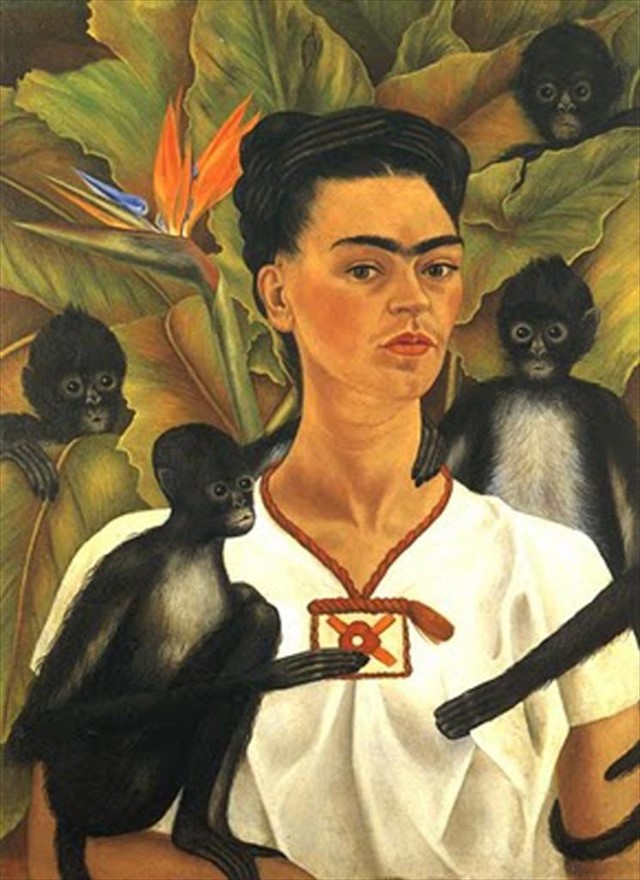
Frida’s stoic and defiant self portraits were the only positive imagery I had of anyone with a monobrow. There was literally no other representation I could find, no Internet to search, no monobrows in magazines or on television unless there was a reference to a character being deeply annoying, ugly, sinister, or cringeworthy (despite a brief media blip about a model growing a monobrow in 2018, things definitely haven’t changed on this front).

Because of Frida I could mostly stand these depictions. Feeling self-conscious I would leaf through the accordion book of Frida’s self portraits my mother had given me, I would recall her paintings that I had seen myself at the National Gallery in 2001. In primary school I would pre-empt scorn by joking to people “I can raise one eyebrow, wanna see?!”

Despite her psychic assistance, and even as Frida’s star image was rising in the popular imagination, the hegemony of two-brow dominance was too much to bear by the time I reached high school. As a teenager Frida came to feel like an awkward relative I didn’t want to associate with, or shameful interior self. I plucked her away, pruning my hair back to little and far-apart slugs.

Seeking repair for my zealous plucking, I went to a beautician and explained. I remember saying “you must see a lot of monobrows” and she just looked at me blankly. It’s a memory soaked with humiliation, and looking back at the pictures of myself in these period fills me with profound sadness, the shame with which I carried my body in the world as if I wanted to hide away.
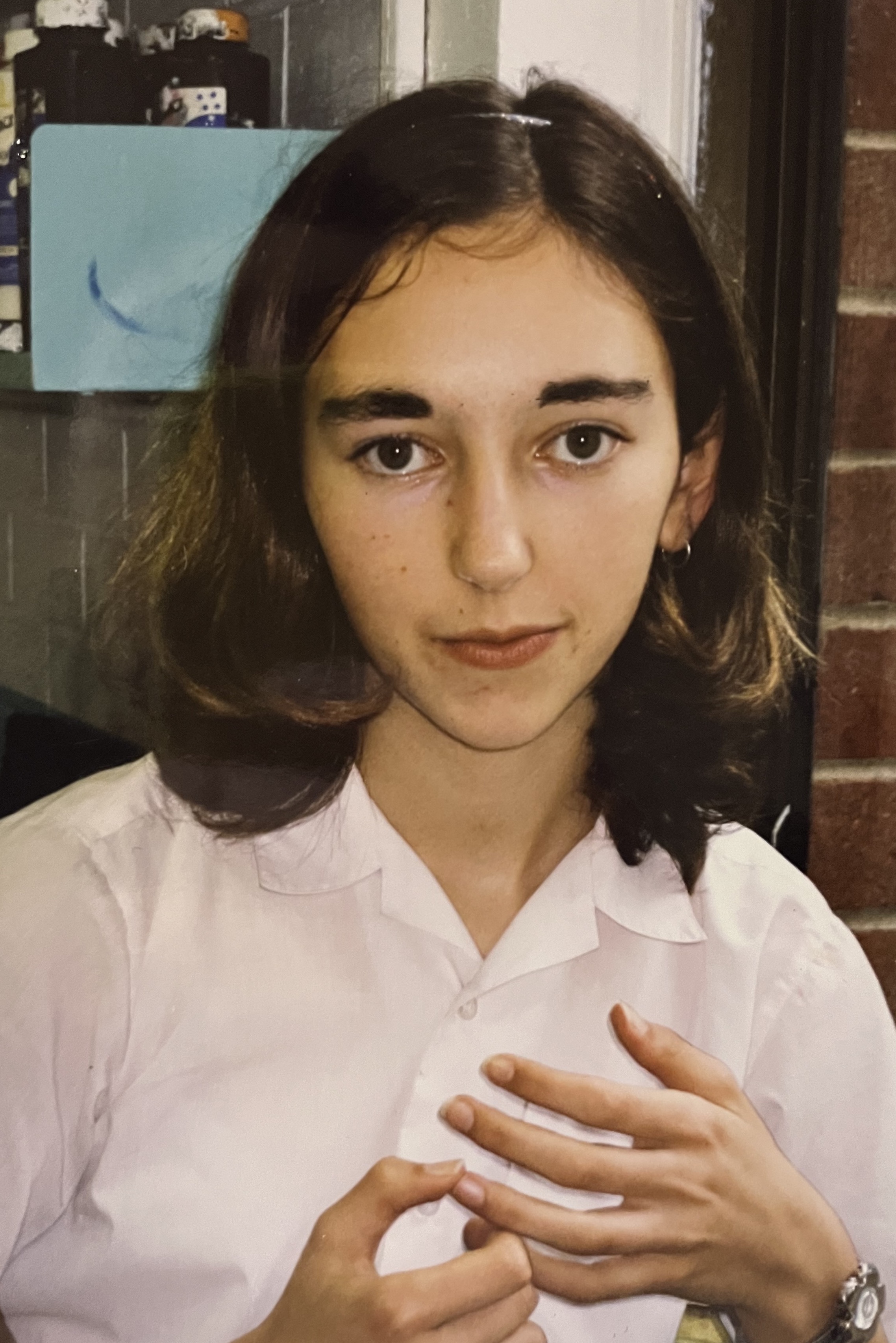
I have been particularly horrified to find that several of the popular books for sale about Frida today (such as “Frida: A to Z“) depict Frida with two eyebrows, and certainly no moustache. This is in spite of the fact that these publications explicitly contain sections discussing the significance of Frida’s monobrow and hair to her constructed image: the way she would enhance her brow with pencil and gel, and emphasise her facial hair in her portraiture.

Perhaps the artistic teams on these books missed the memo, but it seems to me as if she’s been run through a filter of palatability, to suggest that her star as a style icon is only possible by bringing her closer to white patriarchal femininity rather than representing her subversive femme Mexican self-construction. Similarly, when a Barbie version of Frida was released in 2018, she was given a barely-there brow, whitened skin, and an inauthentic style of dress.

The circulation of Frida’s image today feels like a photocopy of a photocopy, a girl-boss-ification that focuses on her glamour, with occasional side notes on her sexual and gender queerness, communism, or pain. She’s on tote bags and tarot decks, and children’s books that simply note her posthumous triumph as an icon. Whether the monobrow is there on not, Frida the artist is often stripped away in favour of Frida the pop-art-like screen print.

Returning to Frida as an adult I feel desperate to understand her, to appreciate her in her complexity and for her artistry. To be as bold as her. As a child I didn’t understand the weight behind Frida’s bloody and bodily paintings, that it wasn’t all about her face. I didn’t comprehend Frida’s accident as a teenager, her chronic pain, infertility and child loss, the importance of her Mexican identity, her communism, her bisexuality, even though so much of this is communicated in her paintings. Recently I bought my young daughter a children’s book about Frida, and though the monobrow is there, the retelling is saccharine: Frida was sad in some of her paintings, but smiling in others! Frida loved life! What does it take to be a feminist icon? Why is it so hard for pain, queer love, loss, to be part of the narrative?

I suspect that even if I had understood Frida more holistically as a child, as more than her monobrow, it would not have been enough to keep the tweezers away.

I sit here fantasising about a future monobrow, un-waxing Frida. I fear there is a gap now that can never grow back.
The Effort of Not Wearing Makeup

article-1041224-0228AC4600000578-286_634x942

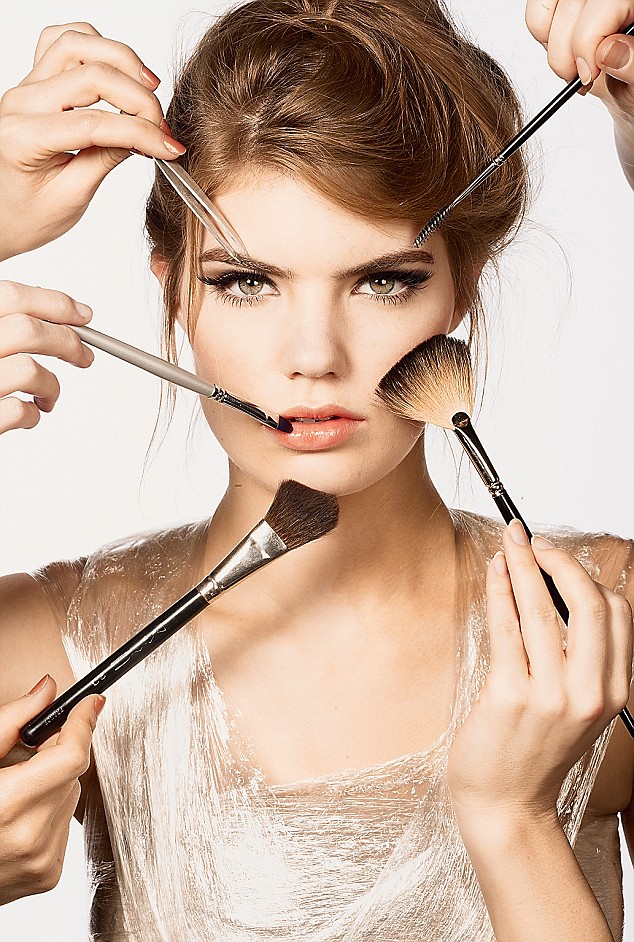
Makeup brushes are the worst. So. Much. Work.

Earlier this year I was diagnosed with a skin condition called melasma and an eye disorder called ocular rosacea. What this amounts to is having brown patches of skin, and red bloodshot eyes. It’s fair to say that 2015 has not been a great year for my face.

The melasma has meant I’ve had to coat myself in serums and sunscreen everyday, leading to vampirically pale skin. The rosacea has also meant I’ve had to stop wearing makeup altogether. Of course I can still wear lipstick, but not if I want to kiss my girlfriend often, which I do (this is another femme dilemma for another time). I’ve gone from someone who used to wear smokey eyes at breakfast, to a blankly pale-faced person.

The whole thing has been quite unsettling. But it’s also taught me a few lessons about my relationship to beauty practices.

I pretty much took my eye makeup cues from this guy

I pretty much took my eye makeup cues from this guy

On an ordinary day, I used to love wearing lashings of mascara, glittery eye shadow and My-Chemical-Romance-levels of eyeliner. Yet I remember that I used to feel so uncomfortable not wearing makeup, that even if I was at home sick I’d get up and put foundation on. I’d also start every morning so mad at the ridiculously long time it would take to put on every beauty product. I would sit at parties and look at the people who weren’t wearing makeup and think “I wish I could do that!” as if showing my un-makeup-ed face was not even an option.

When I was confronted with the new necessarily-pale-faced situation, it was quite a shock. But far from being a relief, I felt more beholden than ever – this time to creams, eyedrops and tablets used to treat my conditions – and worse, without the pleasures that makeup used to bring.

I legitimately own one of these

I legitimately own one of these

With my newly neutral face, I barely recognised myself in the mirror. It seemed like different eyes were staring back at me. Not wanting to brave the world, I was reminded of this quote from Germaine Greer: “The women who dare not go outside without their fake eyelashes are in serious psychic trouble”. I braced myself, and for the next four months went with my new look.

People started to comment on how good my skin looked, how bright, how clear. I looked more sophisticated without makeup, they said. Little did they know I was still wearing multiple layers of various serums, and that any skin brightness had been achieved through months of fierce chemical creams. I was still caught up in the desire to “look good”, just now without any of the fun.

This is what you get when you search for

This is what you get when you search for “natural beauty”

After all, my “natural” make-up free look wasn’t without a great deal of effort. Search for “natural beauty” and I’ll bet you won’t find pictures of someone with brown patches of skin and red bloodshot eyes.

I didn’t feel better without my makeup routine, I felt sad. I had lost a part of my day when I got to “get ready” and activated my persona for the world. I looked at past photos of me and longed for my old face. When I next went to see my eye doctor, the nurse commented on my file, “No mascara? Who does that doctor think he is?! Men, they just don’t understand!”

Recently, I decided to try full makeup again, just for a day. But looking in the mirror I was once again confused by the face that I saw. It made me realise that faces are subject to habit. If you wear the same makeup everyday, it just becomes the baseline.

Pretty sure I couldn't do this to my face anymore, for example

Pretty sure I couldn’t do this to my face anymore, for example

Because my face was always an eye makeup-ed one, the day that changed meant I had to adjust to a new face. But more importantly, a face I could never change or play around with.

The whole series of events has made me think that makeup for me is neither a prison nor a completely empowering practice. There are definitely social expectations that keep me tied to the beauty machine, but there are also pleasures that beauty affords that I never new I’d miss until they were gone.

My doctor now says I can wear some makeup, sometimes. But I think I’m going to try a new face…maybe one that doesn’t fall into habits quite so easily.

The Trouble with “Natural Beauty”

tumblr_ni42kbIse21u8oyeuo2_500

An image from the Tree Change Dolls’ tumblr site

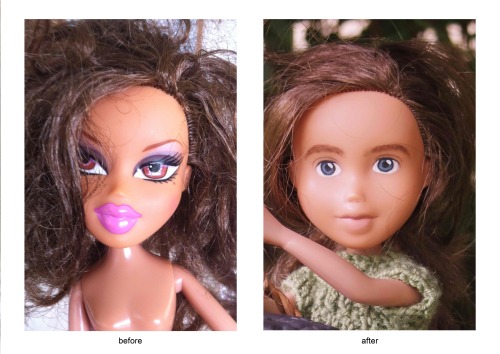
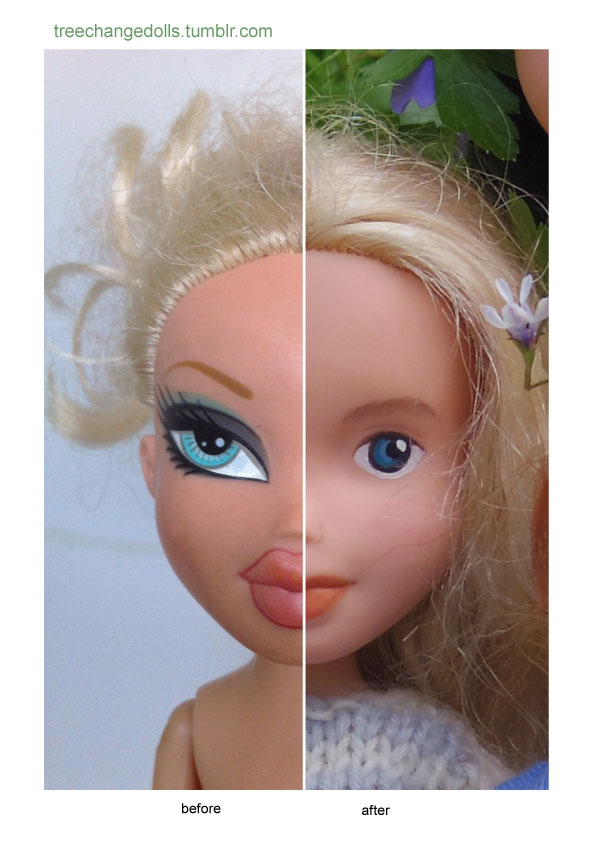
Today a friend sent me a link to a new trend that basically caused me to have a rage blackout: dolls that have been “made-under”. Labelled “Tree Change Dolls“, these are generally hyper-feminine styled dolls (such as Bratz) that have been found at op-shops and transformed through changing their hair, shoes, makeup styles and clothing, to look more normal and natural. In the words of their creator, Tree Change Dolls involve “swapping high-maintenance glitz ‘n’ glamour for down-to-earth style”.

But before you all rush off to procure a Tree Change Doll of your own, it’s worth unpacking what it means to “make-under” a doll. Is it more ethical (as the subtext of the Tree Change Dolls website would suggest) to have a doll adorned with the natural beauty look, rather than the hyper-feminine aesthetic more commonly seen? And why is a make-under really any different to a make-over?

Firstly, let’s look at one before and after image from the site and what a make-under involves:
tumblr_nianihXYdz1u8oyeuo1_12801. Reducing prominent and cartoonish features such as the eyes and lips
2. Removing signs of obvious makeup
3. Conditioning and relaxing the hair which is worn out rather than having it styled up
4. Starting with a naked doll and finishing with a clothed one
5. Maintaining a clear complexion one the face of the doll free of any abnormal markings

Here we can see that the effect of “stripping back” actually mimics a “putting on” of layers. Quite literally the features of the dolls are transformed to conform to a different standard, that of “down to earth style”. In effect, the dolls are not made-under, they are made-over, with the same dramatisation of before and after we would expect from any other visual representation of stylistic aesthetic change.

Another Tree Change Doll, so liberated

Another Tree Change Doll, so liberated

Rather than radically challenging or interrupting expectations of femininity, the Tree Change Dolls set up a new system of signifiers in hyper-femininity’s place: the end result being a set of dolls that all look remarkably similar. The dolls featured on the site all have similar “natural” faces, wear knitted jumpers and 50s-style feminine skirts or alternative-style dungarees, creating an overall effect that looks like the dolls have stepped right off the pages of an alternative women’s magazine (such as Australia’s Frankie), which fetishises the domestic, the home-styled and the “real”. This styling supports a fantasy that one can retreat into a more authentic world of natural beauty, eschewing the limits of oppressive gender norms and escaping the fakery epitomized by the glamour of the pre-made-under dolls.

The pre-made-under dolls have a striking resemblance to drag queens

The pre-made-under dolls have a striking resemblance to drag queens

But, I hear you ask, isn’t a “stripped-back” simple style a less problematic norm than the make-up caked faces of the pre-tree-hugged Bratz dolls and Barbies? Perhaps not. The idea that we might adopt styles of self-presentation as if in a cultural vacuum, supports the circulation of more insidious gender norms. It presents us with the idea that there is a way to look like a “real” girl: and it certainly doesn’t involve wearing visible makeup.

Me playing drag queen at home in my 20s

Me playing drag queen at home in my 20s

When I was a child one of my favourite party themes was “make-up”, and on three separate occasions I held parties where my friends were expected to do-over their own and other’s faces – the only thing being that it was about being crazy, drag-queenish and fun. On my eighth birthday I ended up with green sparkly leaves coming out of my nose, purple fangs and giant blue eyes. The point of this story is that make-up can be about repeating expected styles of beauty, but it can also be very fun. While Bratz dolls might present a beauty style that is over-the-top and homogenous across dolls, the Tree Change Dolls also opt for conformity over experimentation.

As I have written previously, Bratz dolls encapsulate a sheer excess of femininity that is an indulgence rather than a necessity to attract a male gaze. Indeed, with the cult of natural beauty comes a sense that you can’t play around with beauty products or clothing if you want to – you’d just be reinforcing an always-already-oppressive style.

4731141834_dd3530bbf3_b

Monster High Dolls: similar yes, but experimenting with the limits of acceptable presentation

The reason to be deeply concerned about these Tree Change Dolls is that they represent a broader trend toward securing a fixed sense of what a real girl looks like – rather than disrupting the normal when it comes to gender. In fact it seems that Bratz dolls have evolved in recent years – into the now popular “Monster High Dolls”, which, though shiny and long-haired and “pretty”, adopt quirky, strange, monstrous stylings, transforming previous limits around normal looks. While there could be a lot more diversity of styles of gender presentation in these kinds of toys, the worst thing we could do is try and offer a “stripped-back” look that returns us to some kind of original “natural” point. Sometimes the natural might actually be the most fake of all.