Note: The below review contains spoilers for the Barbie (2023) film! If you’d like a discussion that is spoiler-free (recorded before the film screened), check out my chat about bimbos and Barbies on NPR’s It’s Been a Minute with Brittany Luse.
I went and saw Barbie on opening night, and walked right back in and saw it again the next day. The hype around the film has been so immense that I felt like I was holding my breath with excitement and expectation for the whole first screening. Because Barbie is essentially two movies in one mashed together (Barbie and Ken’s stories), as well as kind-of but not-quite being a musical, and definitely a technicolour spectacle, the net result of my first viewing was overwhelm. When I saw it the next day everything made more sense, I knew what to expect. It was much more enjoyable and I highly recommend seeing it twice (or more…I’ll definitely go back).
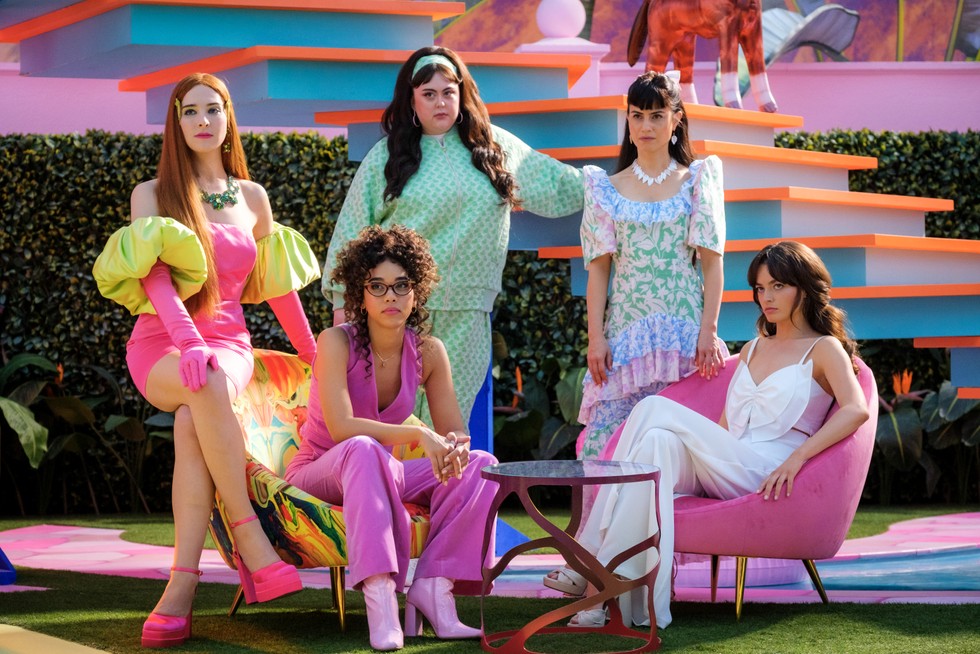
There’s also an interesting point being made here about Barbies as judgemental mean girls
Despite the long lead up to the film’s release, and literally months of speculating about its content, I found Barbie to be so unexpected, joyously unique. I guess even with all my queer hopes I still thought that the film would be more like a traditional blockbuster, with a romantic narrative, or some easy arc to follow. What it actually feels like is an indie director being given the keys (and money) to make an expansively imaginative film, which is exactly what it is! However in being bold it was also sometimes messy, mostly because it was two distinct stories running in parallel: 1) A comedy drama about Stereotypical Barbie becoming human (an inversion of the typical moral panic around Barbie that human girls will try and become like her); AND 2) A musical about Beach Ken grappling with male entitlement and an inferiority complex. Quite different stories in both message, arc, and tone. When Ken walks off in the real world (to stumble across patriarchy), the film splits into two.
Feel the Kenergy
Ironically, comically, I hadn’t thought about Ken, or what his storyline might have to say about gender AT ALL in the lead up. What Gerwig gives us is a very funny meditation on contemporary white masculinity and patriarchy. Honestly Ken’s line that he wasn’t that interested in patriarchy when he realised it wasn’t about horses was so funny, I’ll be laughing about this for the rest of my life. I’ve been listening to “I’m Just Ken” on repeat. Will I buy some “I am Kenough” merch? Uh, yes. Gosling’s Ken, and the whole storyline almost steals the show from under Barbie’s flat feet, but Margot Robbie is so incredibly earnest in her performance that it’s really just a two-pronged circus the whole way through. I do wish Barbie got an equally big musical number to balance it out a bit though.
What is so wonderful about all of the scenes with the Barbies and Kens is how playful they are – as in, literally so silly that it reminds me of playing with toys as a child. The whole Ken fight scene is ridiculous but I can also completely imagine setting that up as a kid, having a war of Kens, on a beach, that turns into a Grease-like dance off where the Kens also kiss. 100% accurate.
If you need a toilet break, this is the scene to do it
The bits that truly sucked in the film were everything with the humans. The parts with the Gloria/Sascha mother/daughter storyline were so two-dimensional, mere props to further the Barbie storyline. Terrible lines. The most asinine feminist speech you can imagine. Inexplicable reactions (like when Sascha first meets Barbie). And the Ruth Handler saccharine ghost stuff? Just the worst. The Mattel humans were less boring, but really because they were more like the toys of the film, silly and hammed up, part of the melodrama, rather than boring interruptions.
I’ve also seen some critiques of the film along the lines of: this Barbie is capitalist. Gerwig tries to double-play the issue of Barbie as a consumer product, with the film nodding and winking to itself the whole way through. This is such a cheap (pun) shot at the film, because what else was Gerwig supposed to do? There is no way to make this film without that critique being levelled. I do think that this hyper-concern over consumption is reserved especially for things associated with femininity though. When the Lego film came out everyone just marvelled at its unexpected communist undertones, and then went and played with Lego. They didn’t bemoan the Lego industrial complex.
Would play with the convertible
Perhaps most importantly (given my projections) the real question is: how queer and feminist is the Barbie film? Well, in terms of its internally stated feminism: lacklustre. We see some lowest common denominator feminism in the dialogue, and interestingly though patriarchy is referred to throughout, the f word is rarely mentioned as an explicit antidote. If I was writing the script, I would have had Gloria the human give the Barbies some 1970s feminist books and start consciousness-raising groups to get them out of their brainwashing, but perhaps this is just my very specific taste as someone who lectures on gender (edit: as a friend pointed out, they kind of try to do this but for a general audience — but what I’m trying to say is it’s consciousness-raising lite!). In spite of this, my hope that this film could – ought to – usher in some feminist media analysis that takes femininity seriously rather than dismissing the text as postfeminist still stands. I would also like to see Ken’s arc analysed here using critical femininity studies, not simply deferring to masculinity studies as the place to explain what is represented (perhaps another post, for another time…).
Barbie has to want to know the truth: that she’s gay
The queerness of the film is stitched into its very fabric, and not just because loads of the cast are LGBTQ+. Though Stereotypical Barbie doesn’t get to make out with any other Barbies (I would have appreciated at least ONE scissoring joke) the implication is certainly that she is queer, because she is queer-coded. From Birkenstocks, to listening to Indigo Girls, to not being interested in Ken, to identifying with “Weird” Barbie, and the Barbie cinema playing Wizard of Oz (all Barbies are “friends of Dorothy”?), the strong hint is that Barbie is not straight. “Weird” Barbie is clearly a euphemism for Queer Barbie, not least because she is played by the famously gay Kate McKinnon, and the rag-tag team she assembles in her house when patriarchy takes over Barbie land also indicates that they are a queer bunch. From Allan (Ken’s “friend”) to Magic Earring Ken and Video (aka Cyborg) Barbie, these are the queer crew, discontinued by Mattel. By the end of the film, after their power-to-patriarchy-and-back-again journey the vibe seems to be that all of the Barbies are “weird”.
You’re telling me this is a group of straight Barbies? Ah, no.
Yet it is also the transness of Barbie that comes to the fore at the very end when she realises her humanness, rather than (as Ruth tells her) having to “want” or “ask” for it. I read this as a trans allegory, where Barbie’s true self is not something she “identifies” as, but something she affirms: she just is. That the last scene involves her visiting a gynaecologist furthers this reading. We don’t know how or when Barbie got a vagina, but she’s so pleased to have one. This doesn’t seem to be a regressive suggestion, that all women ought to have certain biology – and the fact that we learn Ruth had a double mastectomy seems relevant here – but that Barbie realised she was a woman, and wanted certain genitals, which she got. I truly hope this sends the trans-exclusionary activists out there into a tailspin.
Five stars, plenty of notes, but a film I will absolutely cherish forever.
Below is a slightly extended version of an invited plenary panel talk I gave at the Association for the Study of Australian Literature (ASAL)/Association for the Study of Literature, Environment and Culture Aus and NZ (ASLEC-ANZ) Conference, on July 6 in Melbourne, Australia. The theme of the panel was “Uncertainty’s Place”. I donated my speaker’s fee for this talk to the Trans Justice Project: you can donate here.
In my talk today I want to respond to Jennifer’s provocation in the description for this plenary about the potential crossover between reactionary voices on gender and local responses to climate change. It is my hope that in elucidating the enmeshment of these voices that we might be better placed to critique them.
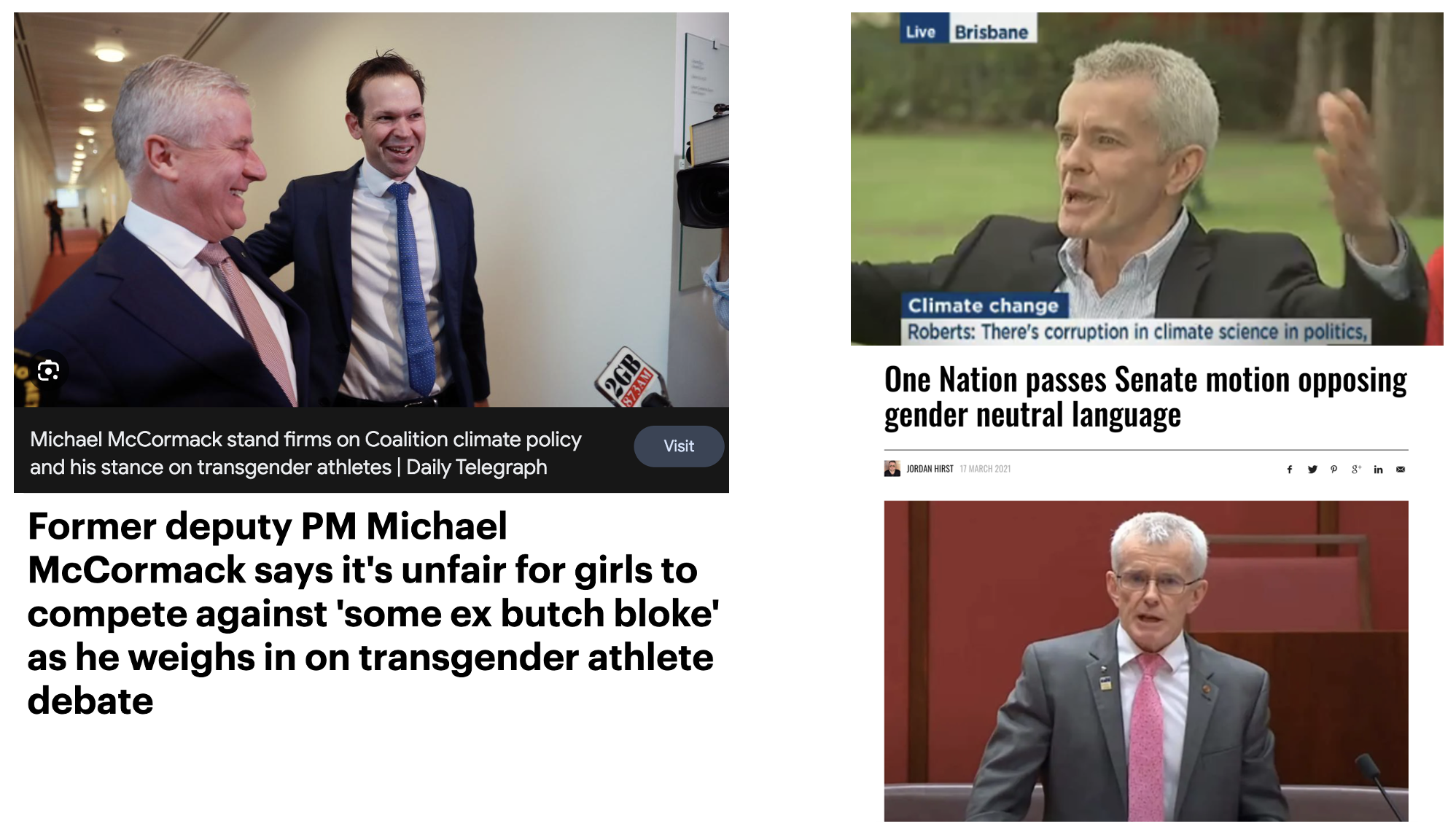
Pictured: examples of rhetorical overlap from conservative politicians on issues of climate inaction/denial and taking anti-trans positions
On one level, the links between reactionary voices on climate and gender might seem obvious: the actors on the right who champion the fossil fuels industry, or who deny climate change altogether, champion reactionary ideas on the topic of gender. In an Australian context we don’t have to look very hard to find examples of this, or the publications that simultaneously spruik these ideologies. However, digging into the coalition of reactionary voices on gender, the picture becomes a little more confusing, the stated positions on the environment a lot more disparate. There is a spectrum of voices in this coalition. From fascists, to traditionally conservative politicians, teaming up with with those who describe themselves as left-wing, some of whom have come out of the environment movement. Is their anti-trans agenda the only thing that unites them?
The aim of this talk isn’t to detail all of the connections between the far right and anti-trans feminists, or to consider the fascist aspects of anti-trans sentiments, as others have explored. Rather, it is to take these self-proclaimed anti-trans feminists at face value (as feminists, as left-wing) to understand what is at the philosophical root of their coalitions with the right over this issue, and, what this possibly has to do with climate change.
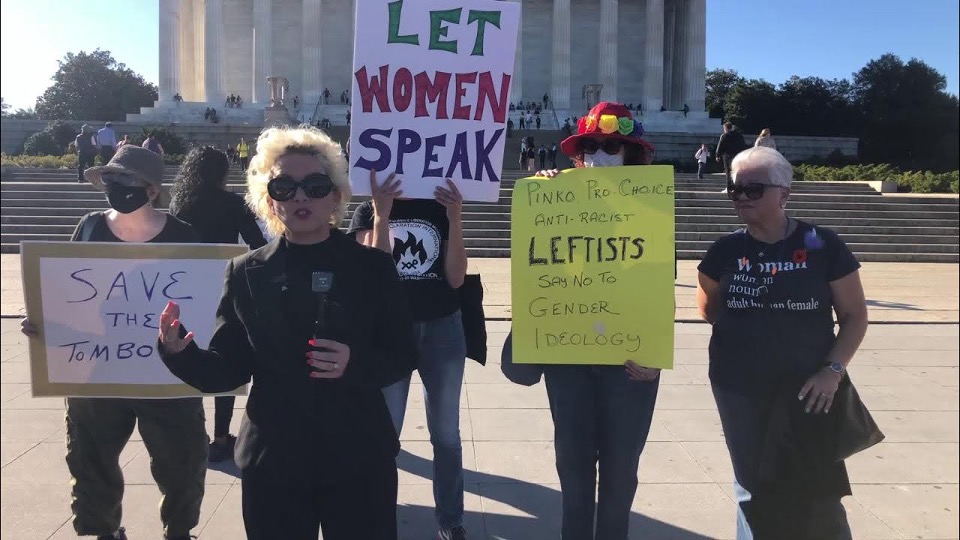
Pictured: anti-trans activist Posie Parker (who rejects the label “feminist”), who led the world-wide tour of the “Let women speak” rally. She is pictured here in Washington with a group of activists, where one of the signs reads “pinko pro-choice anti-racist leftists say no to gender ideology”
The shared term that has been weaponised by those voices opposing gender diversity and transgender rights, is “gender ideology”. We can understand the emergence of this opposition (this “reaction”) historically against the context of the rise of a different mobilisation of feminist activists in the past decade, many of whom are intersectional feminists, and also connected to the #MeToo and Black Lives Matter movements, as well as struggles for LGBTQ+ rights. During this period there has been increasing articulation and media visibility of transgender people and their stories and experiences. There have also been legislative wins in rights for LGBTQ+ people broadly, such as marriage equality, and also around gender recognition and birth certificate laws. In the wake of this activism, visibility, and legislative gains, there has been backlash, from right wing evangelicals and people who call themselves radical feminists (or, “gender critical feminists”) alike.
Images 1-3: The 2017 Sao Paulo protest against Judith Butler Image 4: The neo-Nazi group who turned up to support the “Let Women Speak” rally in Melbourne 2023
In its most right wing and fascistic formations, backlash has focused on so-called “gender ideology” as threat to the nuclear family and thereby the Nation state. For example, in 2017, far-right Christian protestors gathered in Sao Paulo to protest pre-eminent gender studies scholar Judith Butler’s appearance at a local conference, calling them a witch, burning an effigy of them, and claiming that they were out to corrupt the sexual identities of children.
As Butler reflected on this protest: “My sense is that the group who engaged this frenzy of effigy burning, stalking and harassment want to defend ‘Brazil’ as a place where LGBTQ people are not welcome, where the family remains heterosexual (so no gay marriage), where abortion is illegal and reproductive freedom does not exist. They want boys to be boys, and girls to be girls, and for there to be no complexity in questions such as these. The effort is antifeminist, antitrans, homophobic and nationalist, using social media to stage and disseminate their events. In this way, they resemble the forms of neo-fascism that we see emerging in different parts of the world.” We have also seen this fascistic element more locally, in the streets of Melbourne when neo-Nazis turned up to the Let Women Speak rally in March this year.
Left: a poster for the “Why can’t women talk about sex?” event Right: The Binary Australia website header and logo
What we have here is essentially is a coalition of seemingly unlikely allies who are all focused on opposing rights for transgender people. Some are explicitly fascist groups. Some are conservative politicians, often evangelical. Yet some describe themselves as feminists, usually “gender critical” feminists. So, for example in June a talk was held at NSW Parliament House called “Why can’t women talk about sex?”. Speakers included a mix of conservative politicians (e.g. Louise Elliot), activists (e.g. Sal Grover, Katherine Deves), and self-described “gender critical” feminist academic Holly Lawford Smith. It was hosted by a Liberal Democrat MP and also attended by Liberal and Labor MPs. It was broadcast by a new right-wing independent digital media company called ADH TV, and promoted via Binary Australia, the group who ran the “No” campaign against marriage equality in Australia in 2017 and subsequently rebranded to focus on anti-trans issues.
Here, anti-trans activism is the hinge. When it comes to climate change and environmental issues generally within these coalitions, there is divergence. Broadly, some of those actors are climate change sceptics, others acknowledge climate change and argue for nuclear as the solution, and when it comes to the people identifying as radical or “gender critical” feminists some of them are nominally environmental activists, or have come from this movement. So for example, we have conservative Katherine Deves, who unsuccessfully ran for the Liberal party in the 2022 Federal election, who occasionally tweets about nuclear power, and indeed this issue is at the heart of Liberal party debates happening this week at the National convention. Conversely, before pivoting seemingly inexplicably to anti-trans philosophy, Holly Lawford Smith was an environmental philosopher who wrote about the moral duty of individuals to act on climate change. However, tellingly, in Lawford Smith’s 2022 book “Gender Critical Feminism”, she outlines,
“[All things] relating centrally to women’s reproductive role and gender expectations applied on the basis of her being female, will be on the feminist agenda as we’ve outlined it. But climate justice won’t be. Climate justice is an everyone issue, not a feminist issue. And that’s a good thing, because as I have been arguing, when it becomes feminism’s job to smash capitalism and fight climate change there’s a serious risk that feminism simply becomes debilitated by being stretched too thinly, by having too much asked of it” (Lawford Smith, 2022, p.159, emphasis in original). As she also reflects, “Nothing has ever seized my attention and refused to relax its grip like [gender critical] feminism has. I have cared about social justice issues, most significantly in recent years climate justice, but I have never been consumed by them” (Lawford Smith, 2022, p.208).
Image 1: The Deep Green Resistance book co-authored by Lierre Keith Image 2: The logo for the Women’s Liberation Front (WoLF) and an example from one of their campaigns Image 3: An image of the Alliance Defending Freedom (ADF) and an example from one of their campaigns
I want to give one more strange, telling, example of these coalitions in the USA context, before getting to my point. In 2011 Lierre Keith, co-founded the group “Deep Green Resistance front” (DGR), a direct-action group which calls for a “world without industrial civilization” for the benefit of the environment. As their website describes, “When civilization ends, the living world will rejoice. We must be biophilic people in order to survive”. DGR also describes itself as a “radical feminist organisation” and in its statement of principles includes “Gender is not natural, not a choice, and not a feeling: it is the structure of women’s oppression. Attempts to create more ‘choices’ within the sex-caste system only serve to reinforce the brutal realities of male power”. While DGR seems to have fractured over this issue, in 2013 Lierre created another group, the Women’s Liberation Front (WoLF). WoLF organises predominately around anti-trans issues with a stated focus on “abolishing gender ideology”. Despite being nominally in favour of abortion rights, WoLF has received funding from the conservative Christian group Alliance Defending Freedom (ADF) and have co-organised rallies in the USA against trans rights. ADF’s main focus is on ending access to abortion and winding back rights for LGBTQ+ people in the USA.
As C. Libby (2022) explains in their analysis of the links between evangelicals and trans-exclusionary feminists, “Despite their distinct historical and ideological lineages, contemporary evangelical and trans-exclusionary radical feminist positions on transgender issues share an affective resonance… Anti-trans rhetoric today positions transgender rights as part of a larger ‘transgender agenda’ that threatens to endanger women and children and to strip Christians of their civil rights” (Libby, 2022, p.429).
Rather than thinking about these alliances as simply opportunistic coalitions meeting on anti-trans rights, there is something fundamentally shared at the basis of these positions. As we readily see in the WoLF and ADF examples, children are often placed at the centre of their campaigns, as the basis upon which the fight is mounted. My claim is, that what is being conceptually weaponised here, what is fundamentally being fought over is not the present moment, but rather, the future. We can productively turn to queer theorist Lee Edelman (2004) here, who describes how the figure of the Child is often wielded in politics and culture as a symbol of the future, and specifically a future that is founded in the (white) heterosexual nuclear family. Edelman shows how children are symbolically connected to life and reproductive futurity, while queer people are marked as representing death and “no future”.
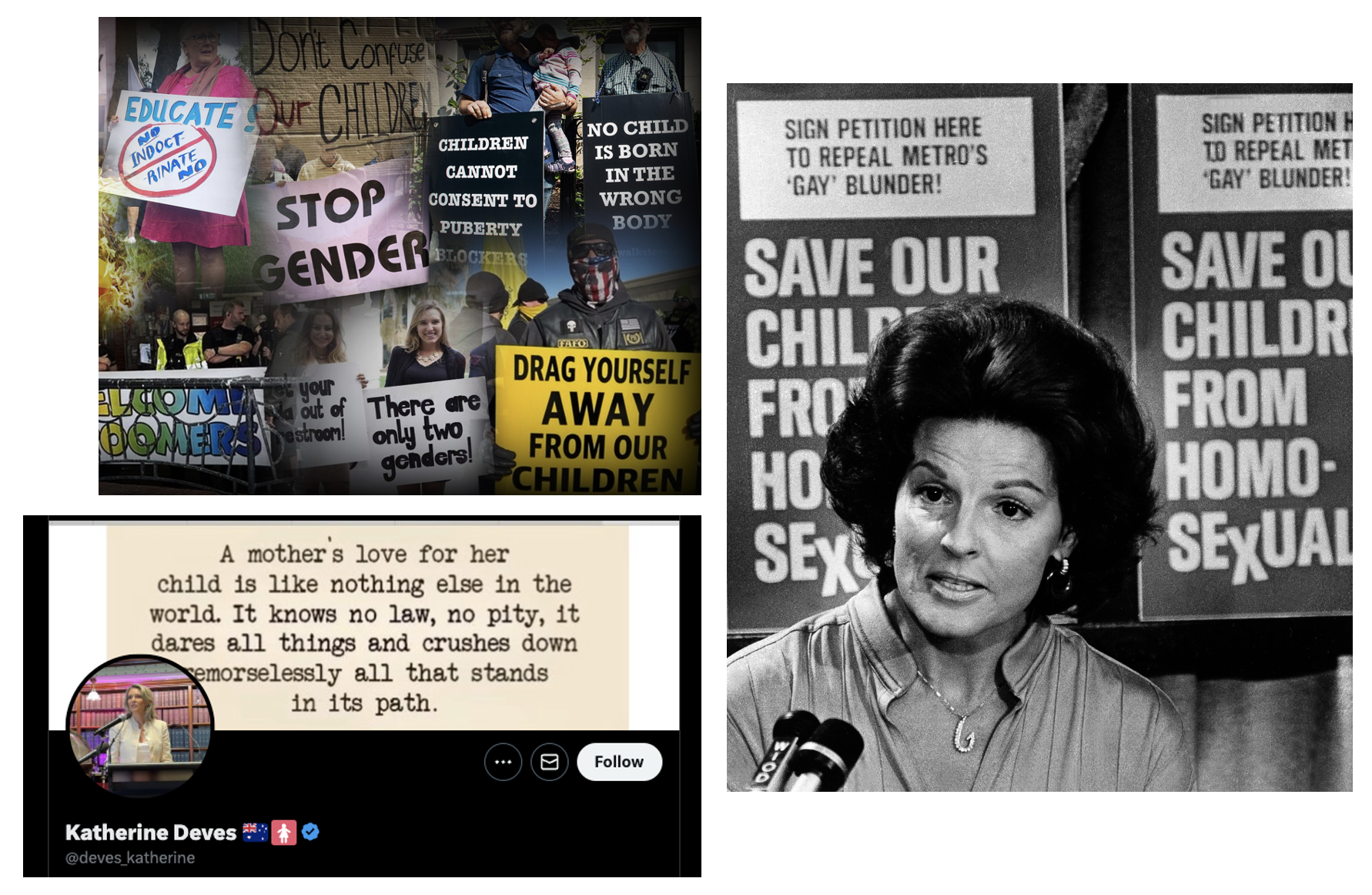
Image 1: A collage of anti-trans protest banners Image 2: Katherine Deves’ Twitter header which reads “A mother’s love for her child is like nothing else in the world. It knows no law, no pity, it dares all things and crushes down remorselessly [on] all that stands in its path” Image 3: Anita Bryant (the original Posie Parker) campaigning against gay civil rights in the 1960s
We see this playing out today with constant fearmongering around the impact of “gender ideology” on children. We see this in “gender critical” calls to “save the tomboy”, to “stop child transition”, and to preserve conversion therapy practices. We see this in the fascist protests that invoke pedophilia and use images of children being “harmed” by “gender ideology”, and at their protests of drag queen story time events at libraries. We see this in the propaganda of sites like Binary Australia, who state their key aim as “protecting children”. We even see this in the social media profiles of failed politicians like Katherine Deves who paints a vivid vision of violence in the name of children. Incredibly much of the language of these protests directly invokes old “save our children” rhetoric seen for example in the USA in the 1960s, with organised campaigns against gay civil rights.
Posie Parker posing with other anti-trans activists in the UK
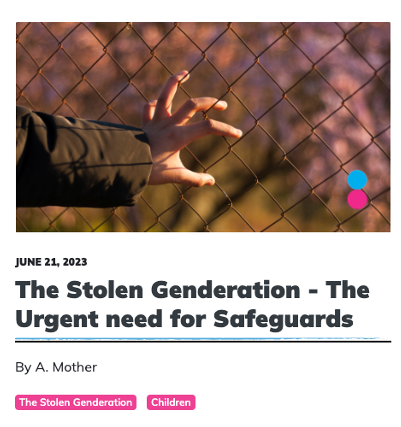
Yet, departing from Edelman what I’d like to point out is that we are seeing in Australia is not just the invocation of the child as the symbol of the future but the white “female” body as the carrier of that child as under threat. Much of this constructs the category of “mother” as the supreme moral arbiter of what is good and right, what is “common sense”. So for example, this piece published by Binary Australia uses the language of the stolen generation of Indigenous children in Australia’s history, washing this of its specific racist history and transposing it onto fear about “gender ideology” as “the stolen genderation”, depicting a white hand against a fence and penned by “A. Mother”. In using this title and image, what is called to mind is a kind of white genocide. When we look at the content of these articles, speeches from conservative politicians, and books by “gender criticals” what we see is a framing of women and children under immense threat: women’s bodies as being “colonised” and “erased”, and sex as being “eliminated”. While these actors may share nominally different positions on climate change, what is shared is a displacement of fear and uncertainty about the future, that is threatened by the shadow of climate change, onto a threat against children and women, with the solution founded in the presumed certainty, materiality, of the sexed body.
An example from the Binary Australia site
Relief from climate apocalypse comes in the name of fabricating a different threat, a war against culture (“gender ideology”) over nature (the sexed body, specifically white cisgender women’s bodies).
As Sophie Lewis and Asa Seresin argue in their (2022) article on the connection between fascism and feminism in today’s anti-trans activism, the view of anti-trans activists amounts to “…an extinction fantasy narrative” or “apocalyptic intoxication”. As Lewis suggests: “I suppose what I am claiming is that the millenarian emergency of ‘female erasure’ imagined by Mary Daly, Sheila Jeffreys, and Janice Raymond is an imminent disaster the cisterhood loves, Cassandra-like, to hate” (p.470). Very similarly Libby (2022) highlights how evangelical pamphlets condemning transgender subjectivity stress “moral decay, contagion, and apocalypticism” (2022, p.426).
The reactionary voices in question are fighting for a construction of the future that is certain: where “boys are boys” and “girls are girls”, where this is founded in a biological guarantee, imagined as a concrete and immutable reality. In the meantime, the status quo can continue without having to challenge the logics of capitalist industrial growth, consumption, or emissions. This is not just the logical consequence of the politics of conservative actors in this coalition against “gender ideology”. In constructing “gender critical” feminism as a “single axis” politics that rejects so-called “burdens” of other axes such as race and class, or concerns like environmentalism (Lawford Smith, 2022, p.58), it cannot help but leave a vacuum for its coalition partners to fill on other issues, precisely because it is purportedly concerned with nothing other than “sex”. Vitally, it promotes climate inaction because they are too focused on fighting a confected culture war. Disaffection, defeatism, and opportunism come together to spectacularly imagine a whole new threat.
Crucially, as Gayle Rubin wrote in 1982, when the fear was nuclear war and the battle was the so-called feminist “sex wars” over pornography and kink, “…it is precisely at times such as these, when we live with the possibility of unthinkable destruction, that people are likely to become dangerously crazy about sexuality… Disputes over sexual behaviour often become the vehicles for displacing social anxieties, and discharging their attendant emotional intensity” (p.137-138). Though in this case now it is gender, “gender ideology” is suffused with a sense of the sexual order under threat. Why sexuality? Because when the future is imperilled – as it is now, with the very real apocalypse of climate change looming overhead – reproduction, imagined as the future of the species, becomes an easy latch, a more manageable apocalypse.
I’ve been thinking a lot about Frida Kahlo lately, as I’ve been asked to speak at the Art Gallery of South Australia’s panel on Frida’s feminist legacy later this week, as part of their “Frida & Diego: Love & Revolution” exhibition. Today, incidentally, is her birthday.
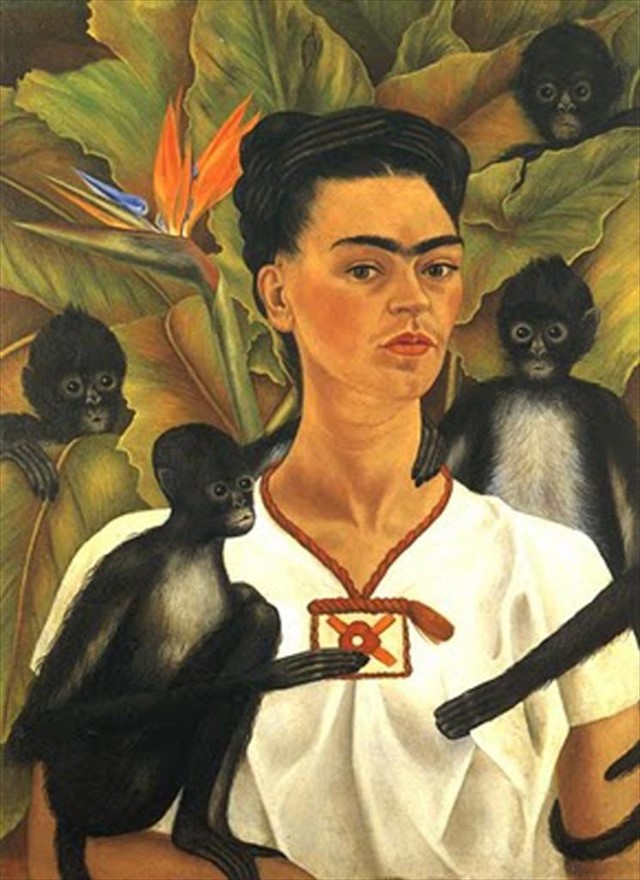
Turning my attention to Frida is a return to childhood for me, when she was a key source of comfort. This was during the rise of “Fridamania”: which spanned from influencing designers like Gaultier in the 1990s, to Salma Hayek’s 2002 biopic, and being famously loved by Madonna in this period. But from memory it wasn’t pop culture so much as my mother who introduced me to Frida, and the reason? My thick monobrow.
Frida’s stoic and defiant self portraits were the only positive imagery I had of anyone with a monobrow. There was literally no other representation I could find, no Internet to search, no monobrows in magazines or on television unless there was a reference to a character being deeply annoying, ugly, sinister, or cringeworthy (despite a brief media blip about a model growing a monobrow in 2018, things definitely haven’t changed on this front).
Because of Frida I could mostly stand these depictions. Feeling self-conscious I would leaf through the accordion book of Frida’s self portraits my mother had given me, I would recall her paintings that I had seen myself at the National Gallery in 2001. In primary school I would pre-empt scorn by joking to people “I can raise one eyebrow, wanna see?!”
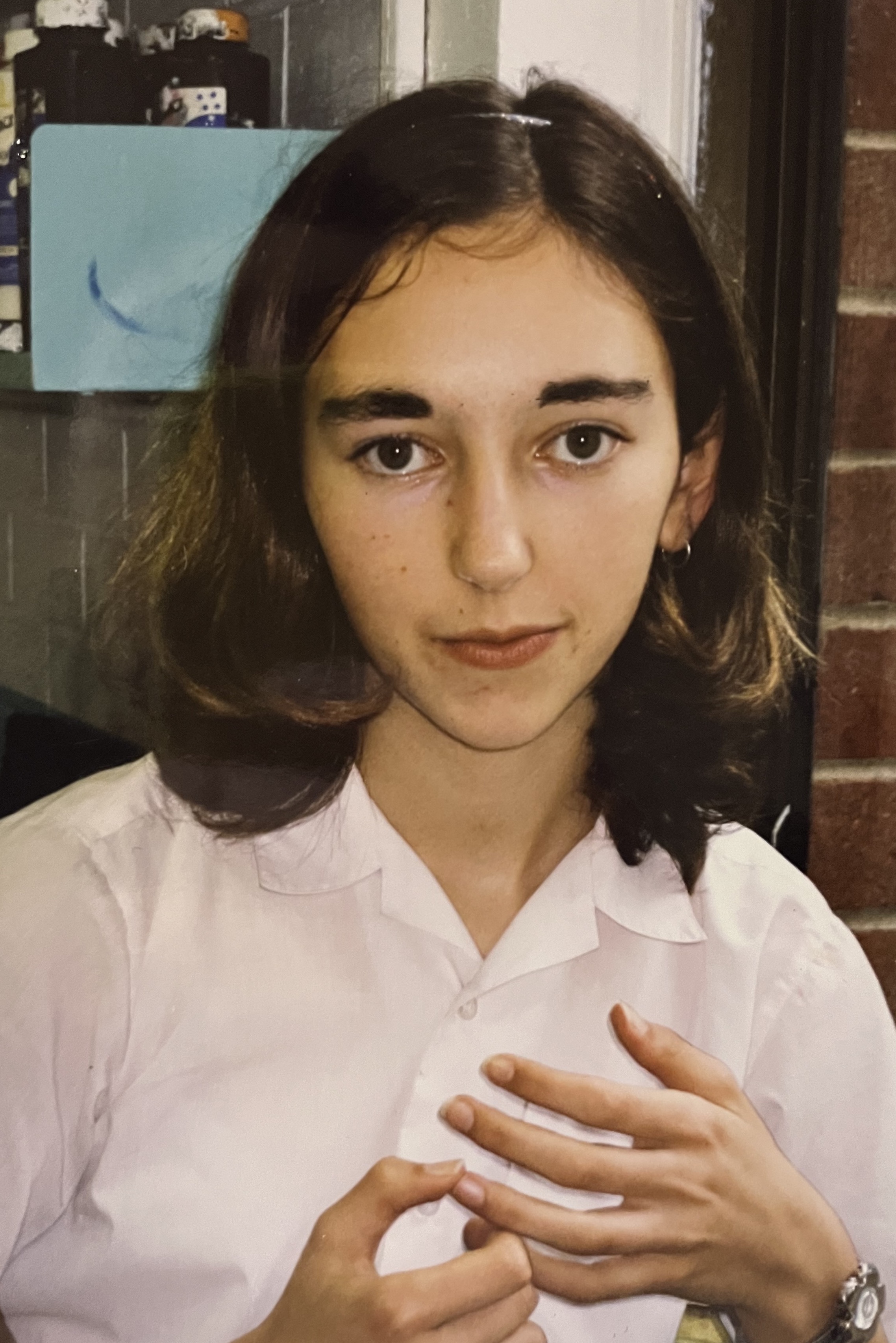
Despite her psychic assistance, and even as Frida’s star image was rising in the popular imagination, the hegemony of two-brow dominance was too much to bear by the time I reached high school. As a teenager Frida came to feel like an awkward relative I didn’t want to associate with, or shameful interior self. I plucked her away, pruning my hair back to little and far-apart slugs.
Seeking repair for my zealous plucking, I went to a beautician and explained. I remember saying “you must see a lot of monobrows” and she just looked at me blankly. It’s a memory soaked with humiliation, and looking back at the pictures of myself in these period fills me with profound sadness, the shame with which I carried my body in the world as if I wanted to hide away.
I have been particularly horrified to find that several of the popular books for sale about Frida today (such as “Frida: A to Z“) depict Frida with two eyebrows, and certainly no moustache. This is in spite of the fact that these publications explicitly contain sections discussing the significance of Frida’s monobrow and hair to her constructed image: the way she would enhance her brow with pencil and gel, and emphasise her facial hair in her portraiture.
Perhaps the artistic teams on these books missed the memo, but it seems to me as if she’s been run through a filter of palatability, to suggest that her star as a style icon is only possible by bringing her closer to white patriarchal femininity rather than representing her subversive femme Mexican self-construction. Similarly, when a Barbie version of Frida was released in 2018, she was given a barely-there brow, whitened skin, and an inauthentic style of dress.
The circulation of Frida’s image today feels like a photocopy of a photocopy, a girl-boss-ification that focuses on her glamour, with occasional side notes on her sexual and gender queerness, communism, or pain. She’s on tote bags and tarot decks, and children’s books that simply note her posthumous triumph as an icon. Whether the monobrow is there on not, Frida the artist is often stripped away in favour of Frida the pop-art-like screen print.
Returning to Frida as an adult I feel desperate to understand her, to appreciate her in her complexity and for her artistry. To be as bold as her. As a child I didn’t understand the weight behind Frida’s bloody and bodily paintings, that it wasn’t all about her face. I didn’t comprehend Frida’s accident as a teenager, her chronic pain, infertility and child loss, the importance of her Mexican identity, her communism, her bisexuality, even though so much of this is communicated in her paintings. Recently I bought my young daughter a children’s book about Frida, and though the monobrow is there, the retelling is saccharine: Frida was sad in some of her paintings, but smiling in others! Frida loved life! What does it take to be a feminist icon? Why is it so hard for pain, queer love, loss, to be part of the narrative?
I suspect that even if I had understood Frida more holistically as a child, as more than her monobrow, it would not have been enough to keep the tweezers away.
I sit here fantasising about a future monobrow, un-waxing Frida. I fear there is a gap now that can never grow back.









 BINARYTHIS