Fascists, Feminists, and ‘Gender Ideology’: A More Manageable Apocalypse  

Below is a slightly extended version of an invited plenary panel talk I gave at the Association for the Study of Australian Literature (ASAL)/Association for the Study of Literature, Environment and Culture Aus and NZ (ASLEC-ANZ) Conference, on July 6 in Melbourne, Australia. The theme of the panel was “Uncertainty’s Place”. I donated my speaker’s fee for this talk to the Trans Justice Project: you can donate here.

In my talk today I want to respond to Jennifer’s provocation in the description for this plenary about the potential crossover between reactionary voices on gender and local responses to climate change. It is my hope that in elucidating the enmeshment of these voices that we might be better placed to critique them.
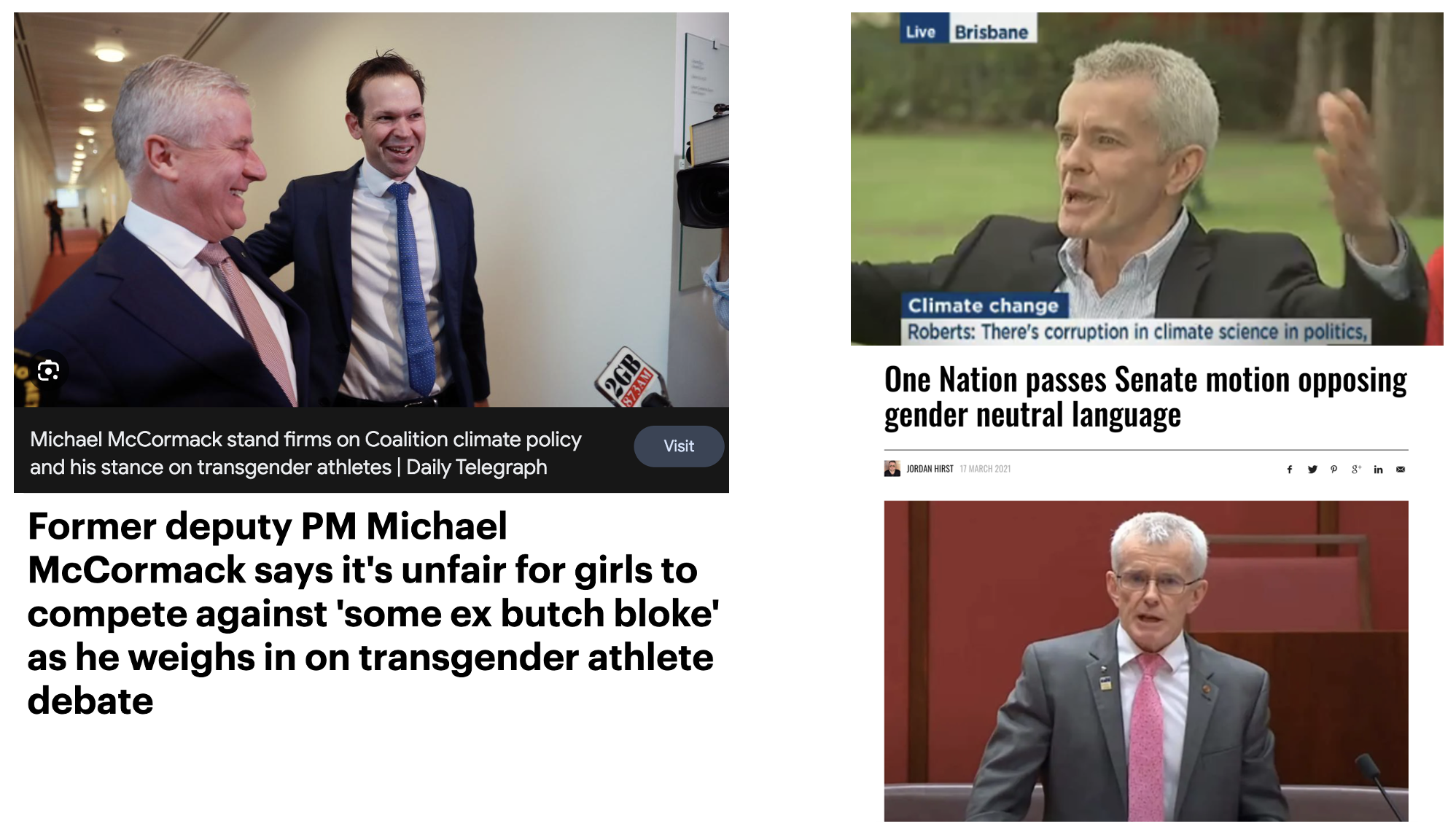
Pictured: examples of rhetorical overlap from conservative politicians on issues of climate inaction/denial and taking anti-trans positions

On one level, the links between reactionary voices on climate and gender might seem obvious: the actors on the right who champion the fossil fuels industry, or who deny climate change altogether, champion reactionary ideas on the topic of gender. In an Australian context we don’t have to look very hard to find examples of this, or the publications that simultaneously spruik these ideologies. However, digging into the coalition of reactionary voices on gender, the picture becomes a little more confusing, the stated positions on the environment a lot more disparate. There is a spectrum of voices in this coalition. From fascists, to traditionally conservative politicians, teaming up with with those who describe themselves as left-wing, some of whom have come out of the environment movement. Is their anti-trans agenda the only thing that unites them?

The aim of this talk isn’t to detail all of the connections between the far right and anti-trans feminists, or to consider the fascist aspects of anti-trans sentiments, as others have explored. Rather, it is to take these self-proclaimed anti-trans feminists at face value (as feminists, as left-wing) to understand what is at the philosophical root of their coalitions with the right over this issue, and, what this possibly has to do with climate change.
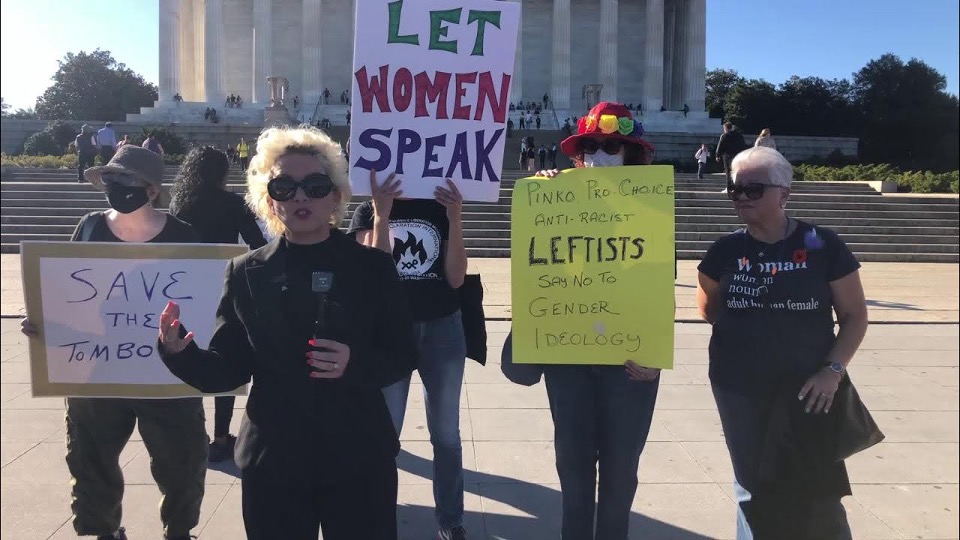
Pictured: anti-trans activist Posie Parker (who rejects the label “feminist”), who led the world-wide tour of the “Let women speak” rally. She is pictured here in Washington with a group of activists, where one of the signs reads “pinko pro-choice anti-racist leftists say no to gender ideology”

The shared term that has been weaponised by those voices opposing gender diversity and transgender rights, is “gender ideology”. We can understand the emergence of this opposition (this “reaction”) historically against the context of the rise of a different mobilisation of feminist activists in the past decade, many of whom are intersectional feminists, and also connected to the #MeToo and Black Lives Matter movements, as well as struggles for LGBTQ+ rights. During this period there has been increasing articulation and media visibility of transgender people and their stories and experiences. There have also been legislative wins in rights for LGBTQ+ people broadly, such as marriage equality, and also around gender recognition and birth certificate laws. In the wake of this activism, visibility, and legislative gains, there has been backlash, from right wing evangelicals and people who call themselves radical feminists (or, “gender critical feminists”) alike.

Images 1-3: The 2017 Sao Paulo protest against Judith Butler
Image 4: The neo-Nazi group who turned up to support the “Let Women Speak” rally in Melbourne 2023

In its most right wing and fascistic formations, backlash has focused on so-called “gender ideology” as threat to the nuclear family and thereby the Nation state. For example, in 2017, far-right Christian protestors gathered in Sao Paulo to protest pre-eminent gender studies scholar Judith Butler’s appearance at a local conference, calling them a witch, burning an effigy of them, and claiming that they were out to corrupt the sexual identities of children.

As Butler reflected on this protest: “My sense is that the group who engaged this frenzy of effigy burning, stalking and harassment want to defend ‘Brazil’ as a place where LGBTQ people are not welcome, where the family remains heterosexual (so no gay marriage), where abortion is illegal and reproductive freedom does not exist. They want boys to be boys, and girls to be girls, and for there to be no complexity in questions such as these. The effort is antifeminist, antitrans, homophobic and nationalist, using social media to stage and disseminate their events. In this way, they resemble the forms of neo-fascism that we see emerging in different parts of the world.” We have also seen this fascistic element more locally, in the streets of Melbourne when neo-Nazis turned up to the Let Women Speak rally in March this year.

Left: a poster for the “Why can’t women talk about sex?” event
Right: The Binary Australia website header and logo

What we have here is essentially is a coalition of seemingly unlikely allies who are all focused on opposing rights for transgender people. Some are explicitly fascist groups. Some are conservative politicians, often evangelical. Yet some describe themselves as feminists, usually “gender critical” feminists. So, for example in June a talk was held at NSW Parliament House called “Why can’t women talk about sex?”. Speakers included a mix of conservative politicians (e.g. Louise Elliot), activists (e.g. Sal Grover, Katherine Deves), and self-described “gender critical” feminist academic Holly Lawford Smith. It was hosted by a Liberal Democrat MP and also attended by Liberal and Labor MPs. It was broadcast by a new right-wing independent digital media company called ADH TV, and promoted via Binary Australia, the group who ran the “No” campaign against marriage equality in Australia in 2017 and subsequently rebranded to focus on anti-trans issues.

Here, anti-trans activism is the hinge. When it comes to climate change and environmental issues generally within these coalitions, there is divergence. Broadly, some of those actors are climate change sceptics, others acknowledge climate change and argue for nuclear as the solution, and when it comes to the people identifying as radical or “gender critical” feminists some of them are nominally environmental activists, or have come from this movement. So for example, we have conservative Katherine Deves, who unsuccessfully ran for the Liberal party in the 2022 Federal election, who occasionally tweets about nuclear power, and indeed this issue is at the heart of Liberal party debates happening this week at the National convention. Conversely, before pivoting seemingly inexplicably to anti-trans philosophy, Holly Lawford Smith was an environmental philosopher who wrote about the moral duty of individuals to act on climate change. However, tellingly, in Lawford Smith’s 2022 book “Gender Critical Feminism”, she outlines,

“[All things] relating centrally to women’s reproductive role and gender expectations applied on the basis of her being female, will be on the feminist agenda as we’ve outlined it. But climate justice won’t be. Climate justice is an everyone issue, not a feminist issue. And that’s a good thing, because as I have been arguing, when it becomes feminism’s job to smash capitalism and fight climate change there’s a serious risk that feminism simply becomes debilitated by being stretched too thinly, by having too much asked of it” (Lawford Smith, 2022, p.159, emphasis in original). As she also reflects, “Nothing has ever seized my attention and refused to relax its grip like [gender critical] feminism has. I have cared about social justice issues, most significantly in recent years climate justice, but I have never been consumed by them” (Lawford Smith, 2022, p.208).

Image 1: The Deep Green Resistance book co-authored by Lierre Keith
Image 2: The logo for the Women’s Liberation Front (WoLF) and an example from one of their campaigns
Image 3: An image of the Alliance Defending Freedom (ADF) and an example from one of their campaigns

I want to give one more strange, telling, example of these coalitions in the USA context, before getting to my point. In 2011 Lierre Keith, co-founded the group “Deep Green Resistance front” (DGR), a direct-action group which calls for a “world without industrial civilization” for the benefit of the environment. As their website describes, “When civilization ends, the living world will rejoice. We must be biophilic people in order to survive”. DGR also describes itself as a “radical feminist organisation” and in its statement of principles includes “Gender is not natural, not a choice, and not a feeling: it is the structure of women’s oppression. Attempts to create more ‘choices’ within the sex-caste system only serve to reinforce the brutal realities of male power”. While DGR seems to have fractured over this issue, in 2013 Lierre created another group, the Women’s Liberation Front (WoLF). WoLF organises predominately around anti-trans issues with a stated focus on “abolishing gender ideology”. Despite being nominally in favour of abortion rights, WoLF has received funding from the conservative Christian group Alliance Defending Freedom (ADF) and have co-organised rallies in the USA against trans rights. ADF’s main focus is on ending access to abortion and winding back rights for LGBTQ+ people in the USA.

As C. Libby (2022) explains in their analysis of the links between evangelicals and trans-exclusionary feminists, “Despite their distinct historical and ideological lineages, contemporary evangelical and trans-exclusionary radical feminist positions on transgender issues share an affective resonance… Anti-trans rhetoric today positions transgender rights as part of a larger ‘transgender agenda’ that threatens to endanger women and children and to strip Christians of their civil rights” (Libby, 2022, p.429).

Rather than thinking about these alliances as simply opportunistic coalitions meeting on anti-trans rights, there is something fundamentally shared at the basis of these positions. As we readily see in the WoLF and ADF examples, children are often placed at the centre of their campaigns, as the basis upon which the fight is mounted. My claim is, that what is being conceptually weaponised here, what is fundamentally being fought over is not the present moment, but rather, the future. We can productively turn to queer theorist Lee Edelman (2004) here, who describes how the figure of the Child is often wielded in politics and culture as a symbol of the future, and specifically a future that is founded in the (white) heterosexual nuclear family. Edelman shows how children are symbolically connected to life and reproductive futurity, while queer people are marked as representing death and “no future”.
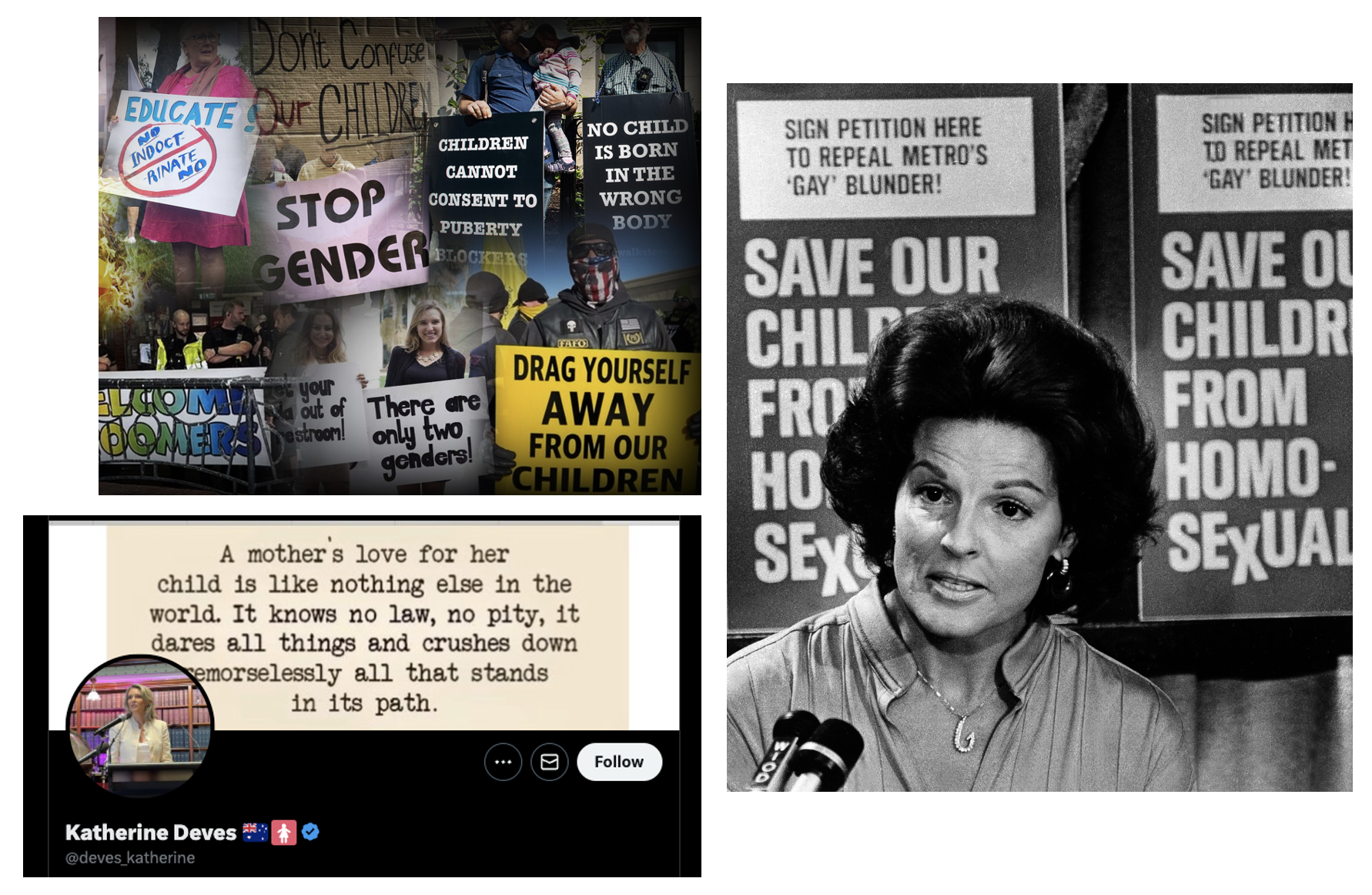
Image 1: A collage of anti-trans protest banners
Image 2: Katherine Deves’ Twitter header which reads “A mother’s love for her child is like nothing else in the world. It knows no law, no pity, it dares all things and crushes down remorselessly [on] all that stands in its path”
Image 3: Anita Bryant (the original Posie Parker) campaigning against gay civil rights in the 1960s

We see this playing out today with constant fearmongering around the impact of “gender ideology” on children. We see this in “gender critical” calls to “save the tomboy”, to “stop child transition”, and to preserve conversion therapy practices. We see this in the fascist protests that invoke pedophilia and use images of children being “harmed” by “gender ideology”, and at their protests of drag queen story time events at libraries. We see this in the propaganda of sites like Binary Australia, who state their key aim as “protecting children”. We even see this in the social media profiles of failed politicians like Katherine Deves who paints a vivid vision of violence in the name of children. Incredibly much of the language of these protests directly invokes old “save our children” rhetoric seen for example in the USA in the 1960s, with organised campaigns against gay civil rights.

Posie Parker posing with other anti-trans activists in the UK

Yet, departing from Edelman what I’d like to point out is that we are seeing in Australia is not just the invocation of the child as the symbol of the future but the white “female” body as the carrier of that child as under threat. Much of this constructs the category of “mother” as the supreme moral arbiter of what is good and right, what is “common sense”. So for example, this piece published by Binary Australia uses the language of the stolen generation of Indigenous children in Australia’s history, washing this of its specific racist history and transposing it onto fear about “gender ideology” as “the stolen genderation”, depicting a white hand against a fence and penned by “A. Mother”. In using this title and image, what is called to mind is a kind of white genocide. When we look at the content of these articles, speeches from conservative politicians, and books by “gender criticals” what we see is a framing of women and children under immense threat: women’s bodies as being “colonised” and “erased”, and sex as being “eliminated”. While these actors may share nominally different positions on climate change, what is shared is a displacement of fear and uncertainty about the future, that is threatened by the shadow of climate change, onto a threat against children and women, with the solution founded in the presumed certainty, materiality, of the sexed body.
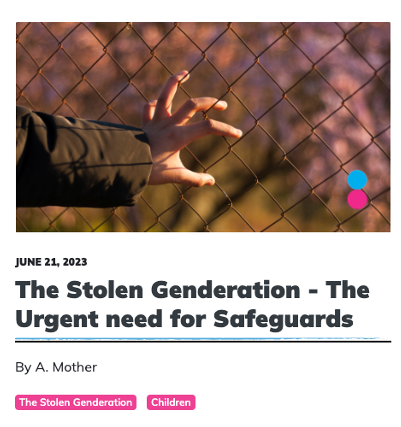
An example from the Binary Australia site

Relief from climate apocalypse comes in the name of fabricating a different threat, a war against culture (“gender ideology”) over nature (the sexed body, specifically white cisgender women’s bodies).

As Sophie Lewis and Asa Seresin argue in their (2022) article on the connection between fascism and feminism in today’s anti-trans activism, the view of anti-trans activists amounts to “…an extinction fantasy narrative” or “apocalyptic intoxication”. As Lewis suggests: “I suppose what I am claiming is that the millenarian emergency of ‘female erasure’ imagined by Mary Daly, Sheila Jeffreys, and Janice Raymond is an imminent disaster the cisterhood loves, Cassandra-like, to hate” (p.470). Very similarly Libby (2022) highlights how evangelical pamphlets condemning transgender subjectivity stress “moral decay, contagion, and apocalypticism” (2022, p.426).

The reactionary voices in question are fighting for a construction of the future that is certain: where “boys are boys” and “girls are girls”, where this is founded in a biological guarantee, imagined as a concrete and immutable reality. In the meantime, the status quo can continue without having to challenge the logics of capitalist industrial growth, consumption, or emissions. This is not just the logical consequence of the politics of conservative actors in this coalition against “gender ideology”. In constructing “gender critical” feminism as a “single axis” politics that rejects so-called “burdens” of other axes such as race and class, or concerns like environmentalism (Lawford Smith, 2022, p.58), it cannot help but leave a vacuum for its coalition partners to fill on other issues, precisely because it is purportedly concerned with nothing other than “sex”. Vitally, it promotes climate inaction because they are too focused on fighting a confected culture war. Disaffection, defeatism, and opportunism come together to spectacularly imagine a whole new threat.

Crucially, as Gayle Rubin wrote in 1982, when the fear was nuclear war and the battle was the so-called feminist “sex wars” over pornography and kink, “…it is precisely at times such as these, when we live with the possibility of unthinkable destruction, that people are likely to become dangerously crazy about sexuality… Disputes over sexual behaviour often become the vehicles for displacing social anxieties, and discharging their attendant emotional intensity” (p.137-138). Though in this case now it is gender, “gender ideology” is suffused with a sense of the sexual order under threat. Why sexuality? Because when the future is imperilled – as it is now, with the very real apocalypse of climate change looming overhead – reproduction, imagined as the future of the species, becomes an easy latch, a more manageable apocalypse.
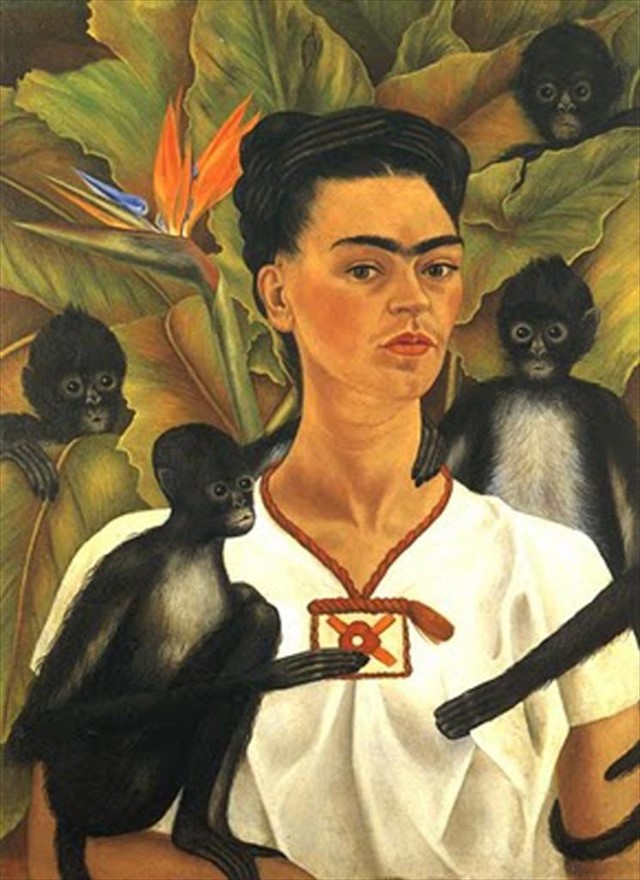
Waxing Frida

I’ve been thinking a lot about Frida Kahlo lately, as I’ve been asked to speak at the Art Gallery of South Australia’s panel on Frida’s feminist legacy later this week, as part of their “Frida & Diego: Love & Revolution” exhibition. Today, incidentally, is her birthday.

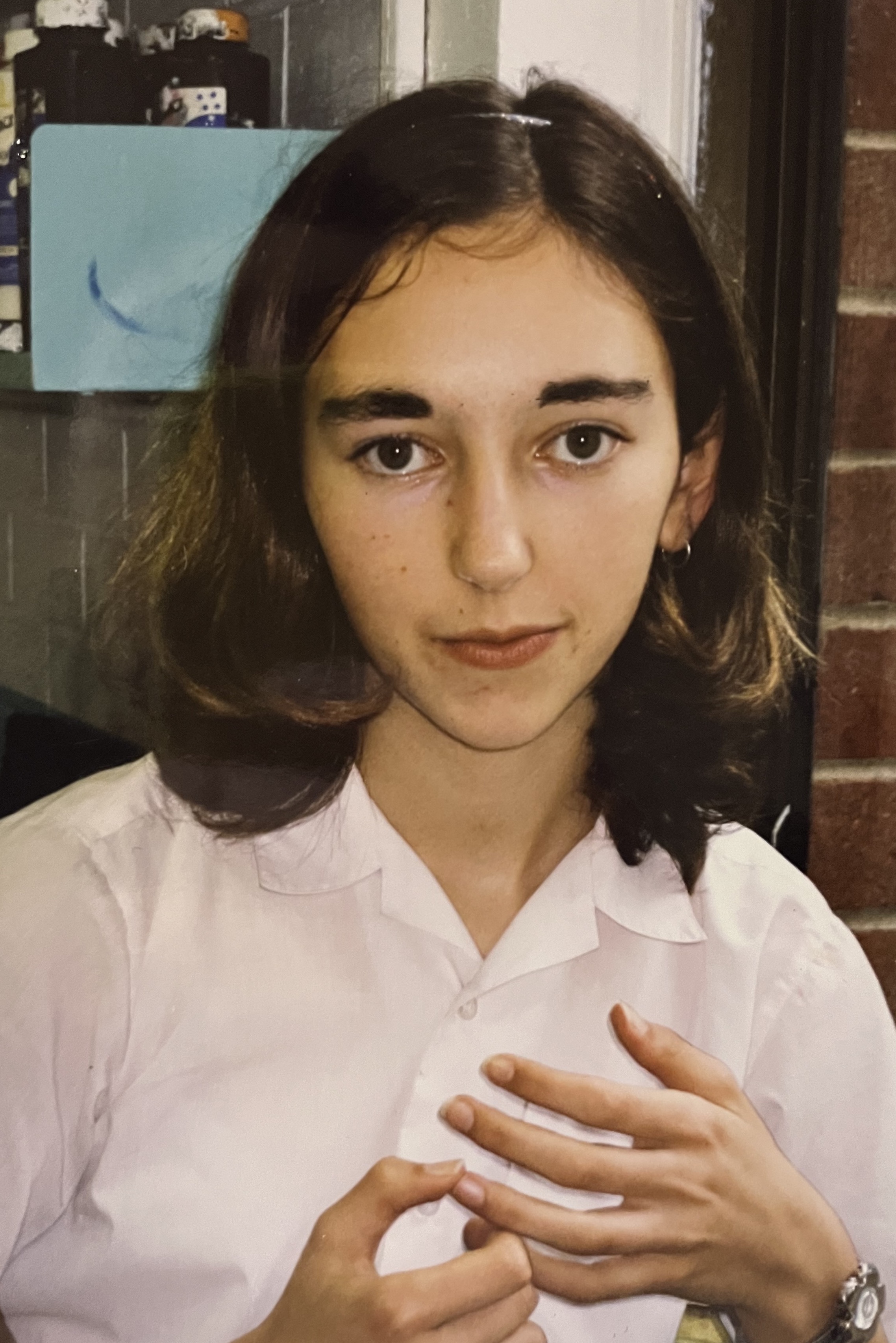
Turning my attention to Frida is a return to childhood for me, when she was a key source of comfort. This was during the rise of “Fridamania”: which spanned from influencing designers like Gaultier in the 1990s, to Salma Hayek’s 2002 biopic, and being famously loved by Madonna in this period. But from memory it wasn’t pop culture so much as my mother who introduced me to Frida, and the reason? My thick monobrow.

Frida’s stoic and defiant self portraits were the only positive imagery I had of anyone with a monobrow. There was literally no other representation I could find, no Internet to search, no monobrows in magazines or on television unless there was a reference to a character being deeply annoying, ugly, sinister, or cringeworthy (despite a brief media blip about a model growing a monobrow in 2018, things definitely haven’t changed on this front).

Because of Frida I could mostly stand these depictions. Feeling self-conscious I would leaf through the accordion book of Frida’s self portraits my mother had given me, I would recall her paintings that I had seen myself at the National Gallery in 2001. In primary school I would pre-empt scorn by joking to people “I can raise one eyebrow, wanna see?!”

Despite her psychic assistance, and even as Frida’s star image was rising in the popular imagination, the hegemony of two-brow dominance was too much to bear by the time I reached high school. As a teenager Frida came to feel like an awkward relative I didn’t want to associate with, or shameful interior self. I plucked her away, pruning my hair back to little and far-apart slugs.

Seeking repair for my zealous plucking, I went to a beautician and explained. I remember saying “you must see a lot of monobrows” and she just looked at me blankly. It’s a memory soaked with humiliation, and looking back at the pictures of myself in these period fills me with profound sadness, the shame with which I carried my body in the world as if I wanted to hide away.

I have been particularly horrified to find that several of the popular books for sale about Frida today (such as “Frida: A to Z“) depict Frida with two eyebrows, and certainly no moustache. This is in spite of the fact that these publications explicitly contain sections discussing the significance of Frida’s monobrow and hair to her constructed image: the way she would enhance her brow with pencil and gel, and emphasise her facial hair in her portraiture.

Perhaps the artistic teams on these books missed the memo, but it seems to me as if she’s been run through a filter of palatability, to suggest that her star as a style icon is only possible by bringing her closer to white patriarchal femininity rather than representing her subversive femme Mexican self-construction. Similarly, when a Barbie version of Frida was released in 2018, she was given a barely-there brow, whitened skin, and an inauthentic style of dress.

The circulation of Frida’s image today feels like a photocopy of a photocopy, a girl-boss-ification that focuses on her glamour, with occasional side notes on her sexual and gender queerness, communism, or pain. She’s on tote bags and tarot decks, and children’s books that simply note her posthumous triumph as an icon. Whether the monobrow is there on not, Frida the artist is often stripped away in favour of Frida the pop-art-like screen print.

Returning to Frida as an adult I feel desperate to understand her, to appreciate her in her complexity and for her artistry. To be as bold as her. As a child I didn’t understand the weight behind Frida’s bloody and bodily paintings, that it wasn’t all about her face. I didn’t comprehend Frida’s accident as a teenager, her chronic pain, infertility and child loss, the importance of her Mexican identity, her communism, her bisexuality, even though so much of this is communicated in her paintings. Recently I bought my young daughter a children’s book about Frida, and though the monobrow is there, the retelling is saccharine: Frida was sad in some of her paintings, but smiling in others! Frida loved life! What does it take to be a feminist icon? Why is it so hard for pain, queer love, loss, to be part of the narrative?

I suspect that even if I had understood Frida more holistically as a child, as more than her monobrow, it would not have been enough to keep the tweezers away.

I sit here fantasising about a future monobrow, un-waxing Frida. I fear there is a gap now that can never grow back.

Bimbo Feminism: Why I’m Excited About the Barbie Movie

If you (somehow??) haven’t heard, there’s a live action Barbie film coming out in July this year, and it looks incredible.

The film has Greta Gerwig at the helm, who brought us previous meditations on femininity including Frances Ha, Lady Bird, and Little Women (seriously someone come do a PhD with me on her oeuvre). Plus it’s co-written with her partner Noah Baumbach who brought us exceedingly depressing reflections on the precarity of the nuclear family with The Squid and the Whale and Marriage Story. With this indie pair in charge you know Barbie is going to be magic.

But the reason I’m most excited isn’t just because it involves two of my favourite filmmakers, and an all-star cast. It’s because I genuinely hope that this film ushers in a new era of critical feminist analysis that takes femininity seriously as a point of theorisation, not so easily written off as “postfeminism”. Maybe we’ll call it “bimbo feminism”. I’ll explain.

Barbie is one of those fraught icons of hyperfemininity. I’m sure I’m not the only one whose caregivers were reluctant about Barbies. I get it. I’ve written recently about how kids clothes are gendered in absurd ways and “for girls” often becomes code for “impractical”. As an icon of girl culture Barbie can get caught up in this. My grandmother gave me a Barbie card for my seventh birthday, and inside there was a message along the lines of “I didn’t get you one because Barbies are sexist” (I’m not joking).

Eventually someone got me a Barbie (“Lights and Lace” Barbie), and I also procured some from an op-shop. I cut Lights and Lace Barbie’s hair short and she lived with her girlfriend in a suitcase apartment with their Barbie cat, and a Ken doll (who was also gay). Do straight Barbies even exist?

On the one hand, Barbie has been abundantly critiqued as an emblem of unrealistic and patriarchal beauty standards. On the other, people have pointed out that she’s done every occupation, and is the ultimate girlboss (eww). On the third, and much more interesting hand, the way people have actually played with Barbies, remixing their hair, outfits, personas and sexualities, reveals Barbie as the GOAT bimbo icon: a blank slate, a fantasy of femininity. She is spectacular plastic with nothing, and thereby everything, to say.

Since the 1990s, feminist critique in the academy has become dominated by dubbing things “postfeminist”. It’s a debated term, but essentially refers to media depictions (or what Ros Gill calls a “sensibility”) that depict feminism as done-and-dusted, within a broader cultural context of backlash against feminism. A LOT of early discussions of postfeminism focused on sex-interested or hyper-feminine female characters as evidencing post-feminism (e.g. via films like Bridget Jones’ Diary or Legally Blonde). Because of the rise of popular feminism in the 2010s, postfeminism is now used a little more expansively to describe an ideology that circulates in popular culture that undermines feminist gains, or is regressive in some way. Problem is, what is dubbed postfeminist/regressive can’t shake the hang up on sexiness and femininity.

Since the 2010s there has also been a parallel development in academia called Critical Femininities (CF). The idea of this field is to give serious attention to studying femininities (in much the same way that masculinity studies has become a proper field), critically but not dismissing femininity as merely, easily, or only patriarchal. CF has been championed largely by queer femme scholars, by people who know what it feels like to be perceived as straight-conforming or not “queer enough” simply because of their feminine gender expression. I have been so excited to see recent CF analyses revisiting “postfeminist” texts like Legally Blonde and the Spice Girls, and arguing for the radical elements of the spectacular femininity therein. For example (and I could quote the whole paper here), Maya Padan’s (2023) close reading of the Spice Girls as pseudo drag queens argues:

The band underscores the performativity of femme embodiments, while using the spices to enable a self-aware inquiry of femininity as a choice, rather than patriarchal coercion. In doing so, the Spice Girls stress how meaningful playfulness is to the construction of gender and how gender can be an arena of exploration (2023, p.13).

Similarly, as Sarah Kornfield and Chloe Long (2023) suggest in their analysis of The Bold Type TV show, “patriarchal and capitalist pressures work to devalue and regulate femininity and to commodify and objectify fem(me)inine people”. In response, they offer “femme analysis [that] resists patriarchy and its interlocking oppressions without positioning women, femmes, or spectacular femininity as patriarchy’s dupes” (2023, p.13).

I love these analyses because they don’t dismiss the rubric of postfeminism as useful, but also offer other ways to engage with spectacular femininity, namely from queer perspectives. One limitation of these account is that they sometimes fly a little too close to “choice feminism” for me, through emphasising “femininity as choice”. The problem with choice feminism is that in responding to the “dupes” argument, it can bend the stick too far in the other direction (I am often guilty of this).

This is where I think bimbo feminism could come in.

Since 2020, interest in bimbo-ism has gained traction via TikTok. There are endless explainers you can look up, but essentially the bimbo movement has been about: embracing styles otherwise derided as hyperfeminine, hypersexual, and/or girly, and emphasising vapidity, that is, feeling over thinking. In other words, celebrating oneself as “hot and dumb”, and encouraging pleasure and leisure over uneven heterosexual relationships and the girlboss grind. Despite their professed anti-thinking attitude, the bimbos of TikTok offer explicit critiques of capitalism, right-wing politics, heteronormativity, white feminism and trans-exclusionary feminism. This is bimbo feminism.

Of course until recently “bimbo” has almost always been used as a pejorative, that’s really the whole point of the reclamation. Some aren’t convinced by the politics of the new bimbo-ism. This morning Jessica DeFino – ex-beauty influencer turned anti-beauty blogger – wrote in her newsletter “From what I’ve seen, the reclamation of ‘bimbo’ by cisgender women essentially means using your words to promote the values of the political left while using your aesthetics to promote the excess of capitalism”. I can (and will) write a whole book about the limits of DeFino’s straight-gaze anti-beauty critique, but her take down of bimbos really misses the (radical) forest for the (pink) trees. For DeFino, hyperfeminine aesthetics “taint” the possibility of real politics. Since when is “using your words to promote the values of the political left” a bad thing just because you’ve got a full face of makeup? And why is spectacular femininity the ultimate signifier of “the excess of capitalism”?

CFS scholar Rhea Ashley Hoskin has written extensively about how intensely femininity is policed, so that it is not “too much”. Femininity is systematically devalued, it is seen as synonymous with “subordination”. Femininity is always seen as being done “for men”. This is, Hoksin argues, “femmephobia”.

As she suggests: “femininity is not taken seriously, it is trivialized, it is considered not very credible, false, untrustworthy, with ulterior motives, anti-feminist and not very intelligent”.

The negative use of the term “bimbo” is after all wielded in such a way to take down people who are perceived as too feminine, too sexual, too vapid, too excessive in their gender presentation.

I’m sure that scholars in the 2000s would look at bimbo feminism and call it “postfeminism” but for me the term has reached saturation. I’m post-postfeminism, I want what’s next.

I feel like the Barbie movie is going to deliver the goods. It’s going to take femininity seriously. Based on the trailers I’m fully expecting a queer critique of capitalism and heteronormativity while dressed in pink glitter.

That’s bimbo feminism.

For the love of dresses

When I was small I distinctly remember having fights with my mother about wearing dresses. While some other queer friends have recounted similar fights, my desire was not to reject dresses that were foisted on me, but rather, I deeply desired dresses while my mother wanted me to wear the more practical and much warmer option of track pants. After lots of fighting (screaming? Tantrums? It’s a kindergarten memory blur) we compromised: dresses over pants. Sartorially questionable, but enough for me to feel like I was wearing the “right” clothing. I think the obsession might have dovetailed with a girl from school asking if I was a boy, and me running home chanting to myself “I’m a girl I’m a girl I’m a girl”.

Despite my awareness, now, of the clear cultural pressures informing my desire, I still love dresses.

I once even created a blog detailing all of the 47 dresses in my closet, the stories behind all of them, and a record of wearing them all in a single month to raise money for charity (which culminated in me wearing a giant gold 1980s prom dress on a teaching day).

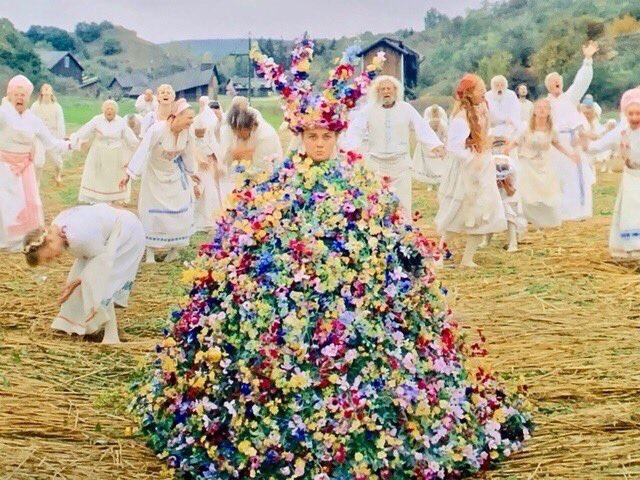
Recently, I bought a dress online because it reminded me of one that I wore to my uncle’s wedding when I was around seven or eight. Of course what I loved then – blaring floral design in primary colours and a 1990s design – doesn’t really translate into my style now. I refer to it as my “Pavlova Mum” dress, the kind of dress you wear when you’ve just baked a pav for the BBQ. Dresses have become symbolically central to my psychic grappling with identity and femininity and I suppose that the “Pavlova Mum” dress-naming hints at my anxieties about becoming a parent who lives in the suburbs. Though, my partner pointed out that it is also reminiscent of the final gown in Midsommar, which makes me like it a little more.

I’ve spent over a decade of my academic career unpacking and untangling my relationship to femininity, thinking through how femininity can be queer, and the confusing and messy space between cultural expectations of femininity and the desire for feminine embodiment. I thought I had come to some kind of resting place with this tension, which might be summed up something like: yes to the capacitating joys of feminine expression, no to the incapacitating expectations of femininity. But I’ve been plagued by these questions (ESPECIALLY thoughts about dresses) since I spent the last year raising a now one-year-old.

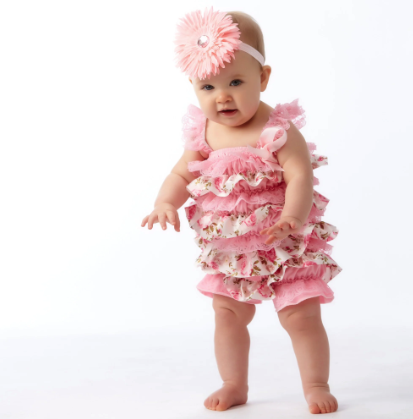
I am watching the world “girl” her in real time. Babies are, unsurprisingly, quite genderqueer little creatures. Often balding post-birth, they are little potatoes that are becoming human. They are learning to use their bodies (to know that they even have bodies), which are growing at an astonishing rate. Babies are all about transformation, becoming, and capacity. The gender designations of “boy” and “girl” seem wildly arbitrary in these early times. Yet. Walk into most children’s clothing stores and you will see the segregation of clothes by the gender binary. Shop attendants will ask you the gender of your child. Parents are sold headbands to cover their bare baby girls’ heads. Since watching the latest season of The White Lotus I have been HAUNTED by the line that Jennifer Coolidge’s character Tanya utters as a kind of self-explanation for her passivity and unhappiness:

You know, when I was a little girl, my mother used to dress me up like a little doll. And I was always a little doll, waiting for someone to play with me

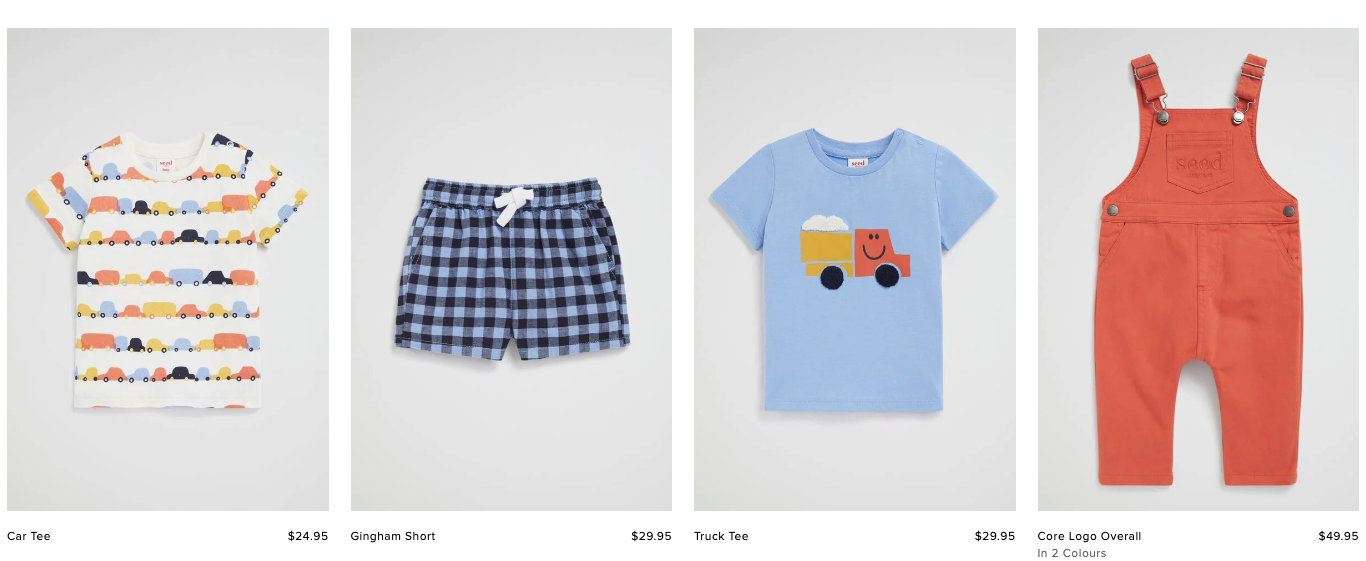
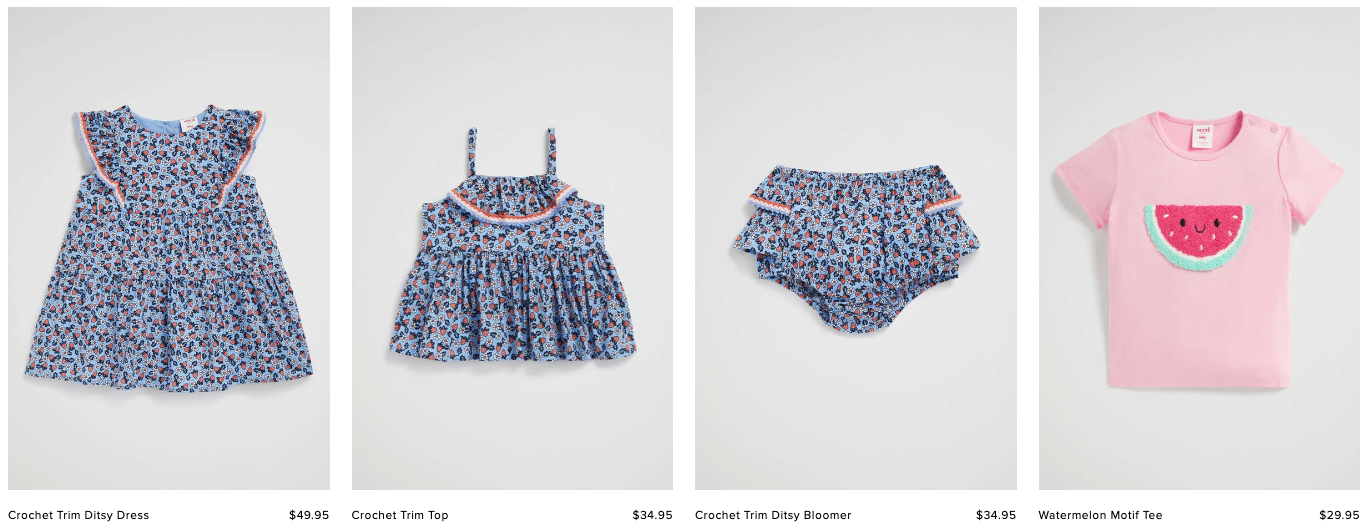
In an attempt to align with my theoretical values around femininity, when it comes to clothes – questions of gender presentation and how the world “reads” you – my intent as a parental dresser has not been gender “neutrality” but rather gender experimentation and options. But try as I might to go shopping for baby clothes with the mindset that “anything goes” I have struggled, deeply struggled, to shop from the “girls” sections of shops. Unless you’re second hand shopping or looking at a designer children’s boutique (often online, very high price points), this is what those sections look like in real terms at chain stores in Australia:

“FOR BOYS”“FOR GIRLS”
FitLoose, longTight, short
PocketsFrequentlyRarely
ColoursDark or neutral – e.g. black, green, blue, greyPastel or bright – e.g. pink, white, yellow, purple
VolumeStraight cutPuffy/billowy/flowy
SunsmartFrequentlyRarely (e.g. short sleeves)
FrillsNoFrequently
ButtonsRarelyFrequently
FabricsHardyOften delicate (e.g. loose weave knit)
PrintsDogs, elephants, giraffes, dinosaurs, lions, crocodiles, trucksUnicorns, cats, flowers, rainbows, ladybirds, rabbits, fruit

The above table is based on my own observations but I’m not imagining it: a study recently conducted in Germany studied 20,000 items of children’s clothing and found that shorts “for girls” are shorter and slogans “for boys” were about being active while “for girls” were about emotions and dreaming. Sometimes these differences are benign and are simply signifying colours, but at other times they are extremely ideological (as the jumpers from the “boys” and “girls” sections of a popular chain below demonstrate).

The thing that I tend to get stuck on the most however is how impractical clothing “for girls” is. Watching my child learning to walk, it is obvious that dresses in particular can be quite incapacitating. “Girls” shorts are shorter, pants tighter, sleeves more clumsy or not covering enough in the sun (as another example below illustrates).

Many a shopping trip has ended with me in a rage, and only purchasing dull clothes from the “boys” section. Of course you can just shop for whatever clothes you like but the point is the very madness of the division in the first place.

That there are these gendered differences in children’s clothing is not new news. It’s a point so obvious to anyone that cares about gender that it feels banal to be bringing it up (again). Yet, I am compelled to bang the proverbial drum of my keyboard to shout look! Are you seeing this! Why is it still like this!

When I’ve shared these thoughts online however, many people are also fixated on the colours and patterns. The pink! The prints! They say. I’ve also found myself internally screaming at frills.

I have to step back and remind myself of my own writing, and theorising on femininity. Because it’s rarely the pink or decoration that is the problem. It is the question of what these clothes capacitate. In an ideal world the segregation of clothes by gender would be abolished, and everyone would have access to pink and frills (though not baby headbands they are simply choking hazards please throw them in the bin) and no one would have to trip over baggy laced sacks while burning their shoulders in the sun.

Then I have to step back, again, and remind myself of my love of dresses.

I brought up this conundrum with a friend and she told me not to overthink it, that my child would assert her own desires with clothes at some point. I’m just acutely aware that none of this is in a vacuum, and I am woefully brought back to the same position my mother was in when I fought with her so hard, a concern for practicality.

I’ll make sure there are dresses on offer. They might just require pants underneath.

Woman Culture and the Gendering of Pregnancy

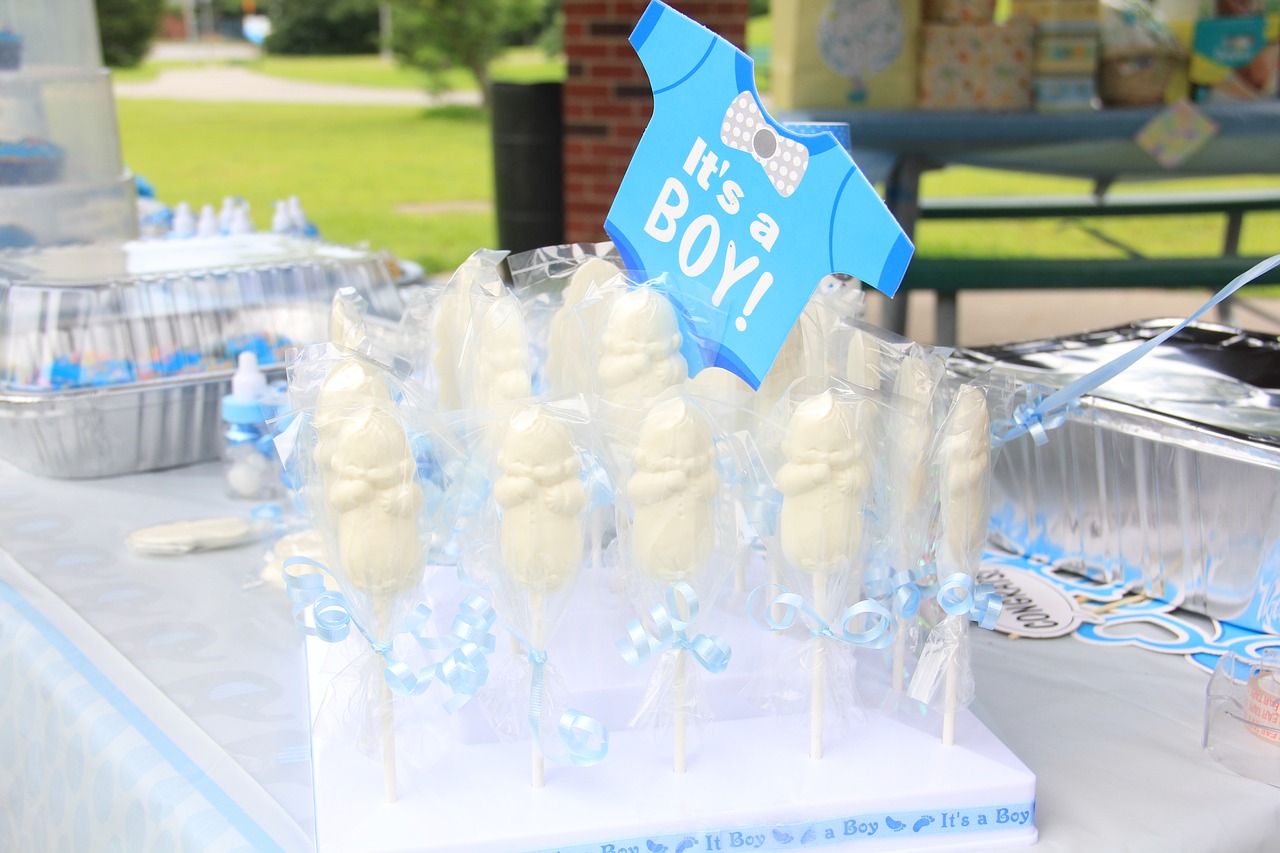
Got to be honest not 100% sure what’s going on in those wrappers

Lecturing in gender studies I have spent a lot of time talking about how children are exposed to processes of gendering, how these operations are intensely social, and that learning about gender does not happen in a parent-centred vacuum. This happens immediately from birth (with the declaration “it’s a boy!” etc), and as Judith Butler (1990) usefully points out, the distinction often made between sex (the biological: including genitalia, chromosomes and other sex markers) and gender (assumed as the cultural interpretation of those markers) is blurry:

“…perhaps this construct called ‘sex’ is as culturally constructed as gender; indeed, perhaps it was always already gender, with the consequence that the distinction between sex and gender turns out to be no distinction at all”

This gendering can even start pre-birth, at the ultrasound, or with blood tests to determine chromosomes. Once sex is designated, an intense process is kicked into gear that involves expectations of how a child will act, what they will wear, and what their future holds (primary assumptions being, for example, that a baby designated female will be feminine, grow up to be a woman, and will one day partner with a man). As I have also discovered being pregnant, there are a whole set of gendered assumptions made between the physical experience of childbearing and the child itself – for example the idea that craving sweets means you are having a girl [*eye roll forever*]!

While I have often thought about gendering in childhood, I have attended less to how pregnancy itself is enrolled in a process of gendering adulthood. What I have experienced as a pregnant person this year has given me some insight into how intensely pregnancy is tied to the category “woman”, and in turn bound up with extremely fixed notions about biology, gender and destiny.

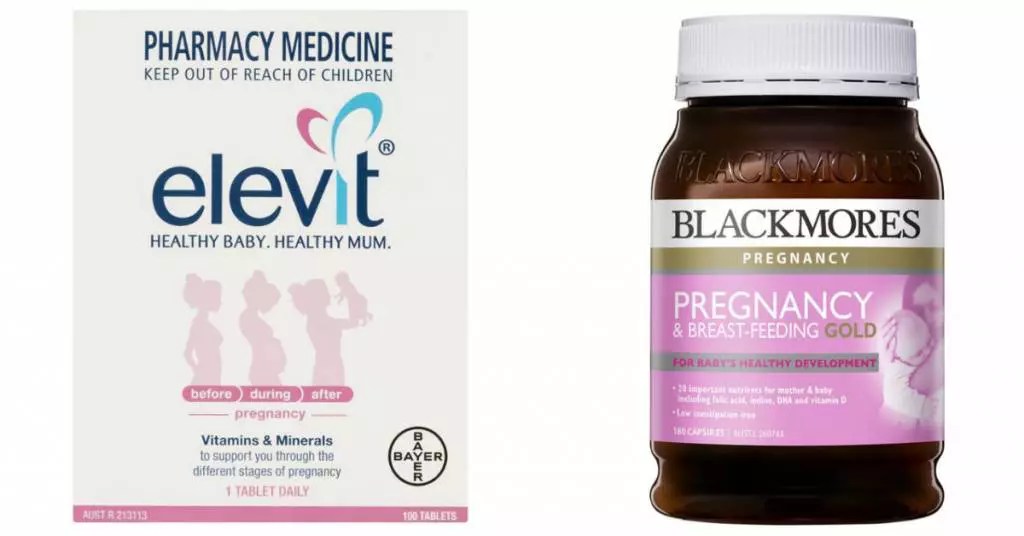
From vitamins to pregnancy tests, the pink and blue coding is inescapable

While I am a bisexual/queer person I am also for all intents and purposes cisgender: I am feminine presenting, use she/her pronouns, and that matches up with the expectation of being assigned female at birth (or, as I am told the pronouncement at my birth was “it’s a feminist!”…something to unpack another time). And yet, I have found the “woman culture” – or what might be more accurately termed “female culture”, emphasising biology – of pregnancy profoundly disorienting.

My first real confrontation with this (aside from the pink and blue aesthetics and white smiling women and babies of pregnancy tests and pregnancy vitamins) was at an early ultrasound. The clinic, like basically everything around pregnancy, emphasised that it was for “women” not only in its name but in every clinical detail. This included the fact I could only find a women’s bathroom there and was made to put on a smock pre-exam that was less neutral gown than actual v-neck lined puffy-sleeved purple dress. The main reception room featured a photograph of a huge pair of high heels with a caption (I’m paraphrasing here): “When the shoes didn’t fit her daughter, the mother simply reminded her she wouldn’t need toes when she was a princess”.

There is a huge emphasis on nature and the natural in pregnancy (never mind how many people used to die in pregnancy and childbirth pre-modern medicine…)

My partner, a man (*constantly* referred to in my pregnancy books and apps as my “husband” despite the fact we are unmarried…), was not allowed to come to the clinic with me and has not been allowed to any of my appointments so far, even with me crying and pleading on the phone about it after some complications, or when I had to go in for an emergency scan. While this has ostensibly been due to COVID-19 restrictions, it has not only intensely reinforced the sense that the responsibility of childbearing is mine alone, but that I am doing this as a (cis) WOMAN whose “body was made to do this” (a saying repeated over and over again to me). It has been distressing for both me and my partner to be separated in this process, and I can only imagine the homophobic layer that partners of the same gender would feel with one parent being constantly cast out.

I am not so disoriented by the physical transition of pregnancy when it comes to gender, despite the discomfort and pain – for me personally it is fun and interesting to have a growing belly, larger breasts, a body full of more blood, and I often think about how not everyone that wants to have this experience gets to. I feel very privileged. I just cannot stand the grate of being told this experience is about divine femininity that connects all (cis) women, that a (cis) woman’s identity is forged through the fires of childbirth, and that pregnancy and labour is some kind of secret business that only (cis) women can discuss with one another.

Fighting stigma and shame around periods does not have to be achieved through emphasising “womanhood”

It reminds me of when I first got my period at 14 and I was happy to have reached the puberty milestone, but also did not think much of it. My mum got really angry at me for not taking it more seriously as the transition to “womanhood” that it represented. She wanted me to celebrate. Her approach was informed by a feminism aiming to reclaim bodily processes which had been shamed and repudiated by patriarchy for centuries. But I did not feel shame, I just wanted to get on with it, and did not want to hold a party for my “entry into womanhood”. There’s a lot of feminist emphasis these days on things like periods and pregnancy because of the stigma that has otherwise surrounded them. That is totally understandable. What is harder to compute is why this has to be enrolled into a “female culture” that emphasises one’s status as woman at every turn.

It would be so easy to use gender neutral language around pregnancy, like referring to “pregnant people” rather than “pregnant women”. It would not harm anyone, it would not “erase women”, it would simply make these spaces more inclusive, and unravel the hard knot of essentialism that pervades reproductive culture. I suspect that many cisgender women enjoy having womanhood emphasised in these spaces though precisely because the misogyny of patriarchal culture means women are rarely celebrated, and pregnancy is one of the few times where one becomes a kind of special icon (where people congratulate you, make room for you on the bus, etc). However the way to resolve this issue is not to double-down on the mother-woman-biology matrix, especially given that ever more queer, trans and non-binary people are bearing children. Given the “female culture” of pregnancy it really is no surprise that it is mother-forum sites like “mumsnet” in the UK that have become the epicentre of anti-trans discourse.
Last night my partner and I re-watched Jeanie Finlay’s (2019) documentary “Seahorse” about one trans man’s experience of pregnancy. I wanted to watch it as I been reading about labour and could not think of any other cultural representations of active labour (aka how it actually happens, not the Hollywood kind where a person gives birth lying on their back). Watching Freddie’s journey through pregnancy as a now pregnant person was so soothing to me, untethered as it was from the “female culture” that has soaked every other pregnancy text I have encountered so far. Importantly in the film Freddie emphasises that his experience is *not* the same as cisgender women, precisely because of the gender dysphoria and difficult social expectations he has to navigate as a pregnant man. There is a scene where Freddie goes through all of the documents from his midwife that emphasise “mother” and “woman” and “female”, and replaces them with words that match up to his experience. Today Freddie is still fighting in court to be recognised on his child’s birth certificate as “father” or “parent”, rather than “mother”. “Seahorse” is a reminder of the small things that we could change culturally that would make a huge difference to the myriad of people experiencing pregnancy, and to thinking about gender broadly.

For now I will keep trying to find a way to navigate this fraught terrain and trying to connect with my body while holding the intense gendering at bay. I suspect this will only become more difficult, in becoming “mother”, and all of the expectations carried with that. Thinking about how we can better support people going through the gamut of reproduction without insisting on rigid gender boxes is a must on the way to loosening the grip of gender expectations in adulthood.

Emily in Paris: Sexless in the City

This post contains minor spoilers for the Netflix series Emily in Paris – tune out now if you haven’t already inhaled the show in one sitting and don’t want to know how long it takes Emily to get to Paris etc.

Emily, immediately in Paris

Emily in Paris doesn’t beat around the bush when it comes to getting its protagonist to said city. Much like a porno film of old, it begins with an extremely brief and tenuous set up including some interactions with a generic boyfriend character (who is quickly cut). Literally only four minutes of exposition later, Emily is rolling down the Champs-Élysées.

It must be said, straight up, that I would best describe this show as utter garbage. After I swiftly watched the whole series, my partner (who deftly avoided it despite being in the same locked-down house) asked me about the narrative arc of the season. The best I could muster was, “Emily succeeded in her job and slept with the guy she has a crush on”. Emily wears some truly terrible outfits, most people hate her, but a lot of men are attracted to her. She never stops working. Paris is beautiful. Not a lot happens.

Emily in bad hats

Some of my favourite cringeworthy lines from the show include:

  • [commenting on a perfume] “It smells like poetry”
  • [after meeting a brand CEO] “I actually have a Masters in Marketing”
  • [after meeting a semiotics professor] “Semiotics? The study of symbols. I have a Master of Communication” [*shrugs*]
  • [on the idea of mistresses] “I’m not somebody that can share a crepe. I want the whole crepe”
  • [on eating an actual crepe] “It’s funny how every culture has its pancake”

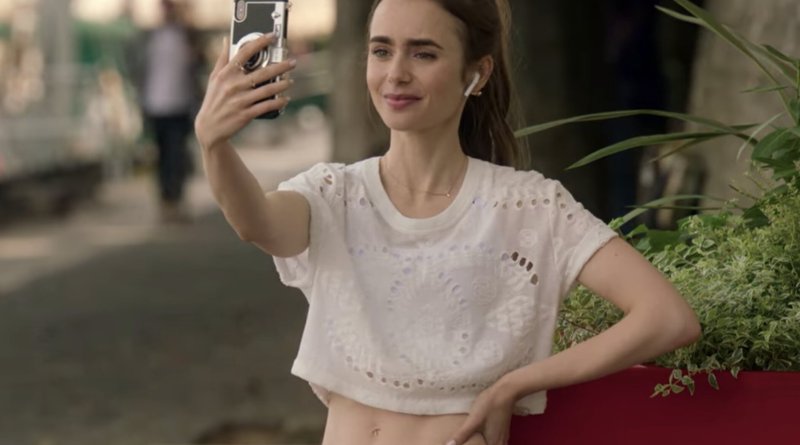
Emily is nominally in Paris to work at a marketing firm and provide “the American point of view”. That is indeed what we get from Emily. She is represented as the hard-working, relentlessly optimistic, severely earnest, unapologetically garish American. But most fascinating (to me), is that Emily is depicted as a strait-laced millennial feminist clashing with her lewd, openly sexual and decidedly “not feminist” French counterparts.

Distancing herself from her sexually liberal postfeminist mom, Sex and the City (SATC), Emily in Paris‘ rebellion entails: a) being au fait with feminism; and b) keeping a lid on sex (or at least keeping the covers pulled up). The creator of Emily in Paris Darren Star was also behind SATC, so there is much we can learn about the mediation of changing mainstream feminist ideas in comparing the two shows.

Emily in between her two much more interesting friends Mindy and Camille

During the 2000s SATC became the key text for feminist critique of “postfeminism” – a term used to refer to the representation of women as capitalising on feminist gains of the past while simultaneously disavowing feminism. For example, as feminist scholar Angela McRobbie remarked of shows like SATC in 2008: “These new young women are confident enough to declare their anxieties about possible failure in regard to finding a husband, they avoid any aggressive or overtly traditional men, and they brazenly enjoy their sexuality, without fear of the sexual double standard”

But while SATC was all about fucking and not mentioning the shadow of feminism, Emily in Paris is all about being a career woman who seems concerned about feminism but is extremely prudish about sex. Emily is a millennial who has come of age in a world where every white woman completed a Masters in Communication and Marketing after watching Mad Men and then became a feminist after Trump beat Hillary.

When is a gaze not a gaze

There is, however, little substance to raising the spectre of feminism rather than disavowing it. As we see in Episode 3 “Sexy or Sexist” Emily’s views on the objectification of women are only relevant insofar as they have an impact on the brand she’s working for. In this episode we see Emily watching a perfume ad being filmed. It features a naked woman strolling across a bridge being admired/ogled by men, wearing “only perfume”. Emily appears shocked after watching the ad. When asked by the brand CEO what she thinks, she suggests that the ad might be sexist, depicting the naked woman as at the mercy of the male gaze. Importantly her French boss Sylvie (set up as a wickedly unfriendly character) not only tells Emily to lighten up, she says that even though she is a woman she herself is not a feminist. Here Sylvie acts as the outdated postfeminist Other to Emily’s American feminist inclinations. When the CEO asks why the male gaze is a problem, Emily responds:

“I’m worried it won’t translate in the States. In today’s climate it could come off as politically incorrect… we just need to be sensitive to the way women are thinking now. I wanna protect your brand!”

Emily’s career mode and life mode are indistinguishable

Emily suggests sharing the ad on social media and asking women to answer the question “sexy or sexist?” to “get a conversation going and…make it part of your campaign”. In other words, taking a political position is redundant. People might think the ad is sexy or sexist, but all that matters is that they end up buying the product. The show is pulling the same move. What do feminists think about sex now? *Shrugs*

Emily represents what I have termed elsewhere “entrepreneurial feminist femininity“. This is a specifically gendered mode that means identifying with feminism, adhering to and reinforcing a rigid gender binary, and most importantly focusing on achieving individual success within the given system of gender relations rather than challenging the system. This is similar to what others have termed “lean-in feminism” or “neoliberal feminism“.

Emily’s relentless optimism always pays off

Emily is distinctly entrepreneurial in spirit. All failures are opportunities for Emily. Nothing can get her down. As Silvio Lorusso argues in his excellent book “Entreprecariat“, precarious employment mixed with entrepreneurial ideology is now the dominant mode of contemporary work, where there is no work-life balance because life is work (and we love it!). Emily in Paris embodies this on every level, with endless references to her American mode of overwork, where no boundaries exist between Emily’s personal life, her influencer life on social media, or her career as a marketing expert. Emily’s feminism is only relevant insofar as it can help her more effectively sell things.

While the show is all about Emily The Career Woman, the sexually explicit aspects of SATC era take a back seat. Despite men seemingly throwing themselves at Emily, the most risqué the show gets is Emily accidentally sleeping with a seventeen year old who gives her a hickey. It’s not even close to the explicitness of Samantha’s endless sex-marathons, Charlotte’s husband-wanking issues, Carrie’s golden-shower dilemma, or Miranda’s boyfriend fingering dramas of SATC days past. And unlike her “heteroflexible” foremothers, don’t even mention the possibility of girl-on-girl action to Emily. Emily insists – over and over – that is something that would never even cross her mind (she “likes to please men”).

My guess is that with future seasons of Emily in Paris (and yes I suspect there will be many many more) part of the grand-er arc will be that Emily becomes more enculturated into the “French ways” meaning slightly less gaudy style and in turn more (under the covers) sex. We’ll get to see just how American feminism today at once distances itself from its “postfeminist” predecessors while making similar – yet decidedly less adventurous – moves.

Of course, I’ll keep watching.

A Theory of Femininity

Book cover

Released with Routledge January 2018

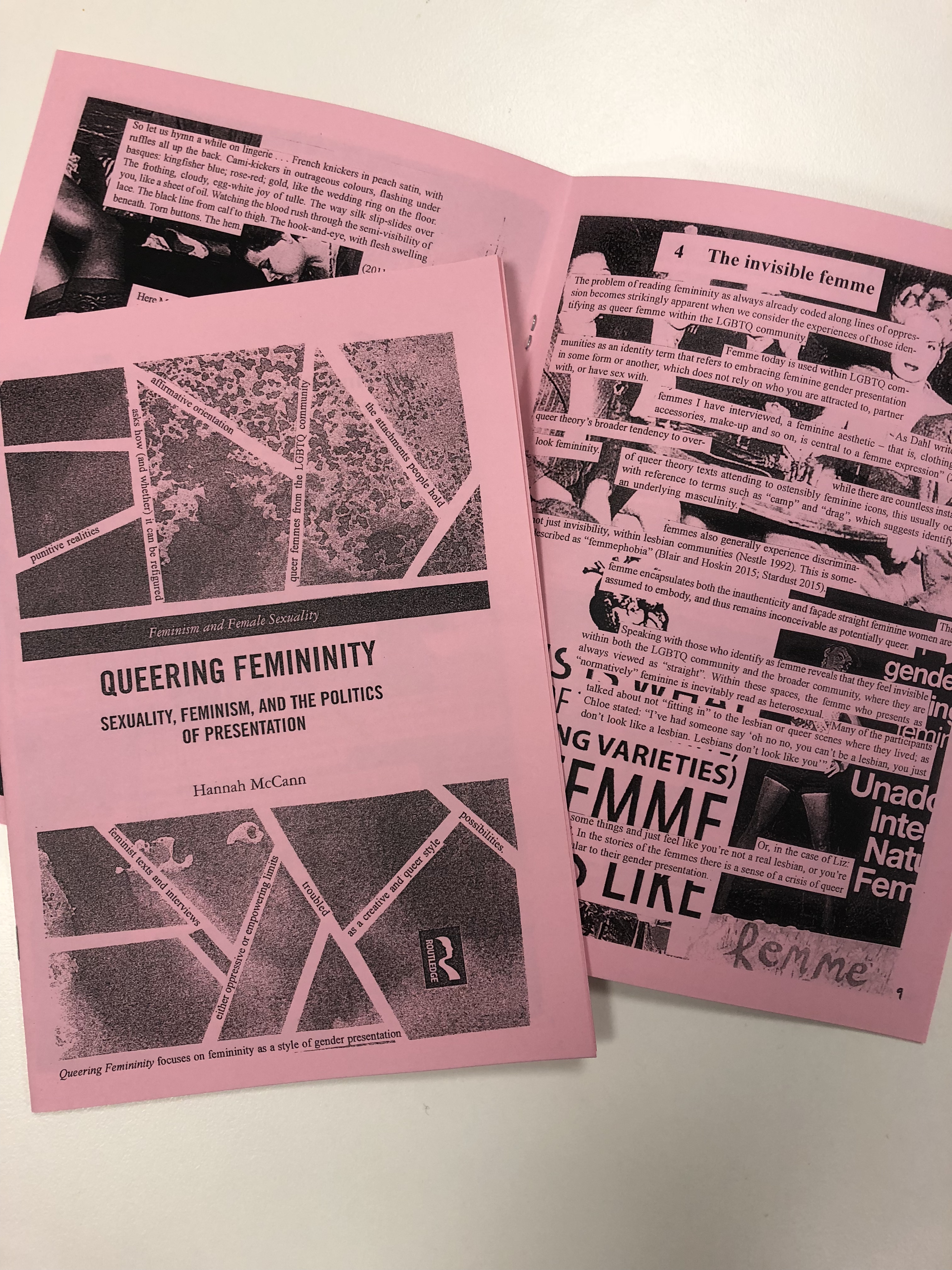
In January of 2018 my first book (based on my PhD research) Queering Femininity: Sexuality, Feminism, and the Politics of Presentation was published with Routledge. I also made the book into a zine for people to engage with given the prohibitive price tag. Queering Femininity engages with both an archive of Western feminist texts and interviews with self-identified queer femmes from the LGBTIQ community in Australia, in order to think through the queer potential of femininity. By ‘queer potential’ I mean, can we ever think about femininity as something that disrupts or ‘makes strange’? Or must we see femininity as always already problematic if we are to engage with it critically?


3DF00306-DC75-4159-A3EE-C29932724306

My zine based on the book

As I found in my analysis of feminist texts, there is (unsurprisingly) a long history of feminist critiques of femininity, where feminine styles of the body are understood as evidence of patriarchal oppression. Here, what is identified as femininity is often collapsed into surface and “masquerade”, even when talking about behaviors or roles. This issue of feminine styles causes issues for those who identify as queer femme, who often find themselves in a space of being unrecognisable as queer in both straight and LGBTIQ contexts (they are assumed to be heterosexual). Yet, I also found that the queer femme response to the inability of the world to see the queer potential of femininity was frequently to over-invest in feminine surface styles (for example, through exaggeration or attempting to signify queer ‘mistakes’ in their presentation). It seemed to me that in many cases this contributed to anxiety about being “queer enough” – an outcome that seemed antithetical to the concerns raised by queer femmes in the first place.

The argument that I attempt to make in response to this conundrum can be summed up in this lengthy paragraph from the conclusion:

To identify precisely who will always fail and who won’t, and in which ways, coheres the normative versus non-normative in ways that misdirect our energies. The aim of all of this must be to see that everyone is failing to meet normative expectations all the time. Everyone’s gender has queer potential precisely because of this ever-present failure. How-ever, we generally only imagine failure as going in one direction: not enough. That is, failure as a failure to meet expectations. However we can also understand failure in terms of “too much”. This is the realm of the “hyper”, the “fake”, the “excessive”. We often refer to “hyperfemininity” but don’t clearly articulate what this means. But we can understand this as meaning the “too much” – too much makeup, too much hair, the heels that are too high, the dress that is too short, the breasts that are too big, the desire that is too rampant, and so on. Interestingly femme often positions itself in this space of the “too much”, the overdone, failing femininity. However, we ought not to rely on the “too much” (or the “not enough”) as our site of resistance because a new norm inevitably fills this space – the norms of not being “too much” or “not enough” (expressed as “not queer enough”). In this way, I take the idea of queer failure to be incredibly useful, but I disagree with Halberstam that “all our failures combined might just be enough, if we practice them well, to bring down the winner” (2011, 120). Under such a rubric, those femmes who would dance around so-called normativity, who manage to “pass” as heterosexual, and who fail to fail enough are sidelined as irrelevant, or assimilationist. Such a view misses the necessity of adaptability to normative fantasies, and the need to pass, or the desire to. While we might imagine a world where our desires could go in different and changing experimental directions, it cannot be overlooked that imagined normative spaces offer cruel but necessary shelters. With this recognition we need not celebrate norms or anti-norms as emancipatory, but rather see that the necessity of such spaces only emerges under conditions where survival is key (2018, 144).

One of the key points I was trying to make in Queering Femininity is that in response to oppressive constructs we too often invest in our individual bodies and identities as the site of the political. This works to dismiss the complex attachments and relations with our bodies and identities that cannot so neatly be enrolled in political projects without serious psychic consequences. Yet, we must still acknowledge that there are normative “ideals” of femininity that are celebrated and encouraged in society, and conversely there are non-normative ways of being (“non-ideals”) that are punished and regulated in violent ways.

Since publishing the book I’ve been thinking a lot more about these claims and how we can effectively think through the relationship between norms, structure, and the activism we commit ourselves to in order to challenge these ideals in productive ways.

Final femininity image

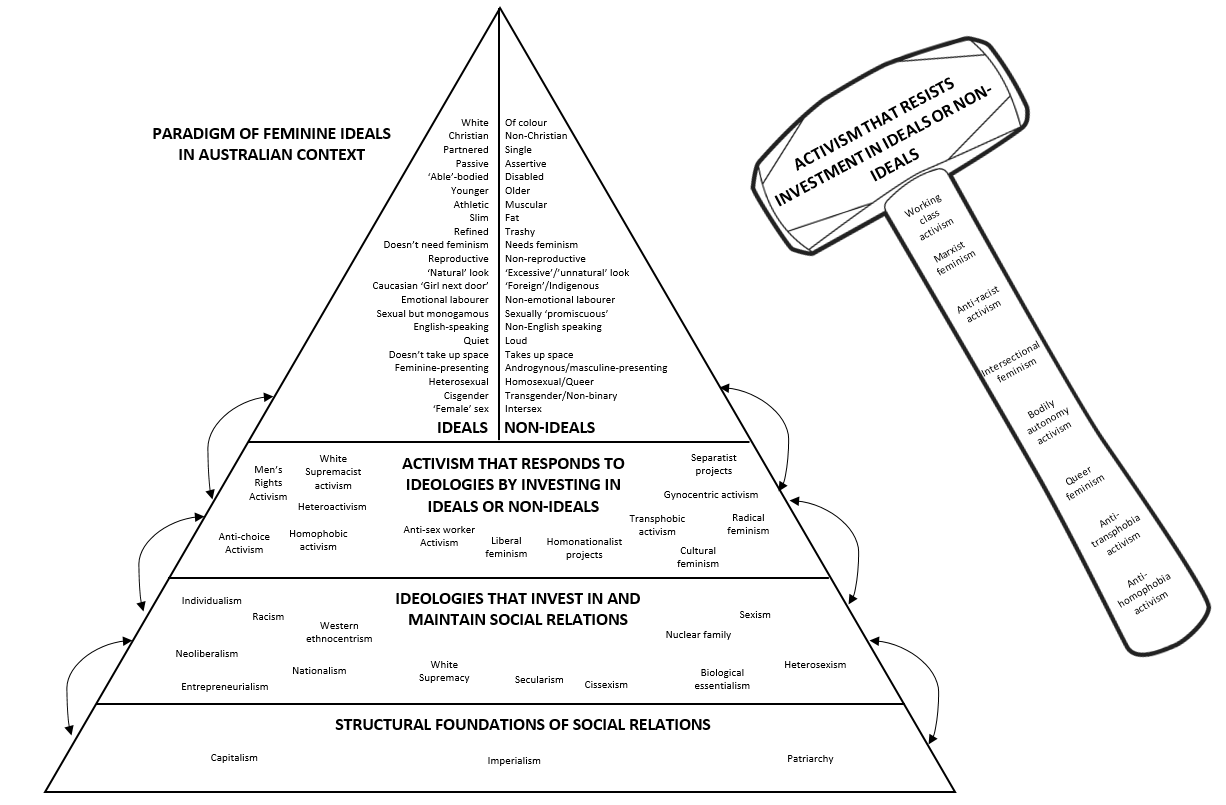
tumblr_static_1069I like to think in visual terms, and the diagram above (click on it to enlarge) is an attempt to sum up how we might connect structure, activism, and norms in a useful way. I’ve included a hammer here as a kind of nuanced update to that “If I had a hammer” image.
This above diagram relates to an Australian context, as a way to localise this discussion and acknowledge that alternative versions of this are needed for different contexts (even if structures are the same, their expression in local contexts may have wildly different effects in terms of “ideals”). This diagram reflects that “ideals” require an oppositional “non-ideal” in order to be intelligible (i.e. make sense). Yet rather than simply presenting the ideals versus non-ideals (which might suggest to the reader that we ought to invest our politics in embodying the non-ideals), this diagram attempts to unpack the activism, ideologies and structure that keep this system of ideals versus non-ideals propped up.

Picture3At the very base are the “structural foundations”, which accounts for the economic, colonial, and gendered power structures that are the foundation of the dominant organisation of social relations in this context. Flowing from this foundation, but also feeding back into it, are the dominant ideologies that invest in and maintain these social relations. For example, neoliberalism is an ideology that supports capitalism. Similarly White supremacy is an ideology that supports imperialism. Flowing from this, there are various forms of activism that respond to these ideologies in ways that either bolster these ideologies or reject them. The activism that bolsters these ideologies also works toward cementing what is understood as the “ideals”.

Picture2It is clear for example, that heteroactivism supports the feminine ideals of heterosexuality, cisgender identity, reproductive bodies, etc.

However, some activism that rejects the underlying dominant ideologies also inadvertently invests in “non-ideals” as a response. For example, lesbian separatist projects advocate for the “non-ideal” of homosexuality, as a political response to heterosexist ideologies. What this does is cement the boundary between the ideal and the non-ideal, by investing in the non-ideal.

This leads us to the heart of the debate around assimilation versus transgression: how ought we to respond politically to “ideals” without simply creating a new set of normative non-ideals in opposition?

This is where the hammer comes in. This represents activism that invests in neither the ideals nor the non-ideals as the political solution. For example, we can imagine forms of queer feminism that challenge ideologies of sexism, heterosexism, cissexism and so forth without advocating queer exceptionalism. The activisms listed on the hammer aren’t necessarily mutually exclusive, so much as drawn out to show how they might go to the heart of challenging the (capitalist, colonial, gendered) structures at the base of ideals of femininity without rejecting or investing in femininity as a style of the body.

Picture1Perhaps this is what might mark out a new wave of (feminist and other) activism around femininity: challenging gender ideals without investing in non-ideals as the political response. From such a perspective, there is no femininity that is “empowered”. Power is exerted and ideals are enforced, but the reaction to this is to focus on the structural foundations and their ideological props rather than the individual effects alone (which might for some involve complicated attachments).

I’d love to hear what you think in the comments below. Does this work at all? Is it useful? Is there anything in the wrong place, or missing altogether? What might this look like in your context? And a reminder: this is only one theory, and, a work in constant progress.

Why Trans-Exclusionary Feminism is Anti-Feminist

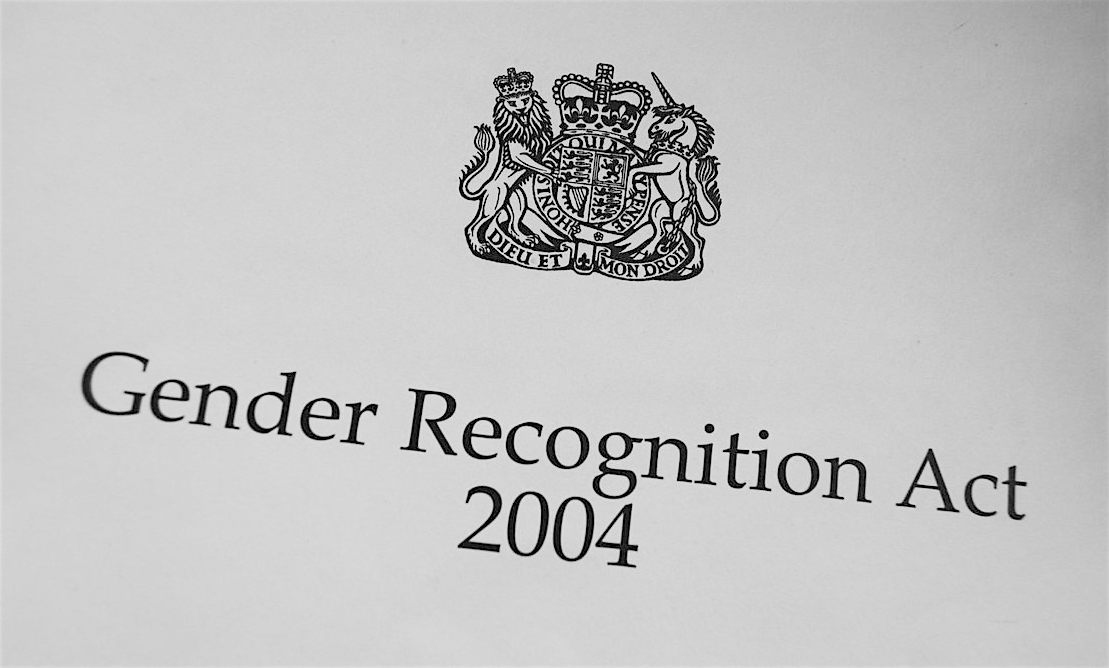
Isn’t it so disappointing when you realise just how problematic your favourite [celebrity/feminist/commentator/Lena Dunham] is? The most recent of these wake-up calls came when I read UK columnist Hadley Freeman’s appalling article in The Guardian, which focuses on changes to the Gender Recognition Act (2004) currently being debated in the UK. Freeman’s concern centres around “self-identification”, that is, the (apparently) radical idea that individuals can determine their own gender identity.

635974934671095018-1669878180_11.17.11news-trull-trans-activists-editFor a bit of background, the GRA allows persons to obtain a “Gender Recognition Certificate” needed in order to obtain a new birth certificate, but currently requires persons to have “lived in the acquired gender throughout the period of two years”. The current Act requires persons to “prove” their case to a Gender Recognition Panel at the end of the two year period. Changes to this process are currently being considered given that it is over-medicalised, bureaucratic and demeaning, and does not currently allow for recognition of non-binary people.

Gender-Recognition-ActIn her article, Freeman praises recent protests against the GRA changes, organised by Mumsnet (a mummy-blog-turned-radical-feminist group). As she outlines, Mumsnet activists have been flippantly identifying as men in order to access men’s-only swimming sessions, to “prove” how “ridiculous” self-identification is. The fear, according to Freeman, is that changes to the GRA will mean “predatory men could now come into female-only spaces unchallenged”. Freeman also laments trans critiques of reproductive-organ-centred feminism, but then takes a u-turn and suggests that the real problem is all of the “liberal men” she’s been fighting with lately who have been trying to defend trans women (Jeremy Corbyn to thank there in part, I imagine).

il_570xN.1149917172_8vmkI was shocked that The Guardian would run this on Transgender Day of Visibility (or at all, and without any responses in the week following), but also at the huge amount of praise that Freeman seemed to receive online for “speaking out”. Though I am a cis woman and don’t speak here as a trans person, I feel obligated to challenge Freeman. The trans-exclusionary ideas bolstered by Freeman’s article should be extremely concerning to any feminists who would like to see a world where gender is liberated from violent rules and strict social expectations. Here’s why:
1. The pathologisation of gender isn’t good for anyone
Pathologisation means determining what is “normal”, and “treating” people to better align with the “normal”. Imagine. Being subjected to a bunch of medical practitioners and psychologists considered more of an “expert” on your identity than you are. Imagine having to “prove” that you have “lived in the acquired gender” for two years (never mind how weird the terminology of “acquired” is, as if gender identity is an effect of an injury or serious accident). This whole process risks reinforcing ideas about what “acting and looking like” a man or woman involves, that is, the gender role and presentation expectations that feminists have historically fought against.

transfeminism-500x421Luckily, changes to the GRA would reduce the clinical barriers needed to have gender identity recognised, which would mean less stress and burden for trans people and would reduce some of the pathologising elements of the process. If gender was truly liberated, we wouldn’t need to diagnose what expressions of gender are “normal”, we would celebrate a diversity of expressions, embodiments and feelings.

2. Feminism should reject the idea that gender is solely about biology
At this point there might be some people reading this who are thinking “BUT THERE ARE LADY PARTS AND MAN PARTS AND THAT IS SCIENTIFIC FACT”. I’m not going to give you an introductory gender studies lecture here (though it might help to read some Fausto-Sterling). I will say that the point of feminism shouldn’t be to work out exactly how “gender” works on a biological “sex” level, but rather, to fight for gender emancipation beyond the narrow dictates of biology. In basic terms that means we should be fighting for people’s ability to live a happy and healthy life no matter what chromosomes and dangly fleshy bits they had at birth or not. Seems obvious eh.

tumblr_n4chv8Kp7V1suxeeyo1_500-300x300As Simone de Beauvoir famously stated, “One is not born, but rather becomes, a woman”. Her main point was that the barriers women face are not naturally determined by “sex”, but rather, are the result of a sexist society where women are enculturated into the punishing rules of “womanhood”. Meanwhile, the Freemans of the world would prefer much stricter barriers about who counts as a “woman”, and thus sit in direct contradiction to de Beauvoir. When Freeman says, “there are significant physical differences between male-born bodies and female-born ones, and the latter have long been at a disadvantage” she strangely re-naturalises sexism as founded in biology. Ironically such an approach merely strengthens the rules of “womanhood”, rather than understanding that the issue definitely isn’t as simple as birth-biology (we are left wondering, for example, what about trans men in all of this?!).

3. Being trans-inclusionary doesn’t mean we have to stop talking about bodies
Taking on board the idea that “one is not born…a woman” doesn’t mean we should ignore the material body altogether, as if bodies aren’t at all relevant to identity or feelings or our experience of the world. Just because the rules of gender are “social” doesn’t mean that these rules are not deeply felt and embodied, or perhaps feel at odds with one’s bodily experience.

6eaa122977ccb679383bedef266050c3Freeman claims that there is a massive issue with trans feminists who critique the centring of reproductive systems. She states, “I’m trying to think of anything more patriarchal than telling women to stop fussing about vaginas at a Women’s March”. What Freeman misses is that the issue isn’t talking about bodies and the material experience of gender altogether, the problem is creating a reductive version of feminism where vagina = woman and where this is made into the central focus of collective action. This doesn’t mean we can’t talk about issues like abortion, pregnancy, or periods either (all issues which affect a range of gendered peoples), it just means that we shouldn’t make biology the basis for our collective resistance.

4. Lots of people experience violence because of gender and that could be the basis for solidarity 
Making things harder for trans people won’t make cis women safe from gender based violence. Trans and gender non conforming people are subjected to staggering levels of violence on a daily basis, particularly in places like the UK where trans-exclusionary debates are rife, and where commentators like Freeman can get a platform with little rebuttal. It is a strange thing to claim that reducing the burdens on trans people via the GRA somehow endangers cis women, particularly when you don’t generally need whip out a birth certificate to access things like swimming pools or change rooms.

42B7CC9A00000578-4733888-image-a-4_1501115365120The claim that somehow “predatory men” will be emboldened to “come into female-only spaces unchallenged” is a transphobic furphy that’s been trotted out by right wing commentators for a long time now, and that has been extensively debunked. Instead of this smokescreen argument that merely acts to reinforce transphobic ideas, understanding the violence that trans and gender non conforming people also experience could be the basis for a shared movement against gender-related violence. The fact that gay men are also often the target of hate crime on the basis of homophobic ideas that gay men aren’t “manly” enough or are “too feminine” could also be something to keep in mind in terms of collective action here.

The fact that Freeman turns to “liberal men” as her problematic interlocutors in the trans feminism debate is absurd (hello, there are cis women who disagree with you too!) and it shows just how much she: a) doesn’t see solidarity beyond anti-trans cis feminists as an option; and b) sees “men” as the problem, rather than the (sexist, racist, homophobic) system. The ability to have a solid political response to issues around gender and transphobia isn’t determined by biology. That doesn’t mean cis men should be dominating panels on trans inclusion, but it does mean we shouldn’t see these men as the problem. The real problem is transphobia, let’s not get confused here.

tumblr_ow1ckfDbLX1ryh1zlo1_500If all of this seems pretty basic, it’s because it is. Fundamentally it doesn’t matter what  the relationship between biology (“sex”) and identity (“gender”) is, what really matters is treating human beings with dignity and celebrating the possibilities of gender. Because loosening the rules of gender, understanding gender and sexism beyond biology, talking about body issues but not reducing people to bodies, and thinking about how to have solidarity around the lived experiences of gender, should be fundamental to feminism. The alternative – the world that Freeman seeks to enforce – is not only a trans-exclusionary, it works against what decades of feminists have been fighting for.

Further Reading:
Kate Bornstein’s Gender Outlaw
The Transgender Studies Reader edited by Stephen Whittle and Susan Stryker
This amazing Transgender Studies Syllabus from Amy Billingsley
The Keywords special issue of Transgender Studies Quarterly
This report on LGBT Hate Crime and Discrimination in Britain 2017
This great video from ABC Comedy, So You Think You Can Trans

Edit: An earlier version of this article stated that the Gender Recognition Certificate would be used in place of a birth certificate, but is in fact used to issue a new birth certificate. For more information see: https://www.gov.uk/apply-gender-recognition-certificate/what-happens-next

Review: Jamila Rizvi’s Not Just Lucky

9780143783534Jamila Rizvi’s recently released book Not Just Lucky is basically a very long riff on the old saying, “carry yourself with the confidence of a mediocre white man”. This is a very useful adage, which works as a reminder of the ways that women are socially conditioned. I find myself repeating this saying to women in my life frequently, and it’s useful to have a  book that spends time unpacking ways that women are brought up with negative self-beliefs.

Rizvi is intent to present “solutions” not just “problems”, and so the book also provides a lot of extended advice on how to speak, dress, think, and act in ways that might get you ahead as a working woman (even though the book claims it’s not a self-help book, but a “career book”). It’s funny and well-written. I also appreciated the very organised bullet-point lists of recommendations – I daresay Rizvi and I are a similar collection of letters on the esoteric Myer-Briggs test.

FullSizeRender

Obligatory selfie of me reading Not Just Lucky

But while I found myself nodding along to many of the passages exploring the sexism that women experience in the workplace and beyond, Rizvi’s solutions fall short. What is offered is at best a band-aid to the problems described, and at worst, a cruel promise that working hard and undertaking individual self-betterment can lead to certain success.

To be fair, Rizvi acknowledges from the outset that her book doesn’t have the solutions for fixing structural problems like childcare and the wage gap, but simply offers ways women can change their thinking that has resulted from structural enculturation.

I’m on board with women undergoing some gender-CBT, heck my job is literally to talk about gender and double standards and how things we think are innate are in fact social.

original

I am more than ready for the “lady boss” obsession to end. Please end.

But presenting the antidote to women’s ills as endeavoring to be “brilliant” and offering a blueprint for how to succeed as a “lady boss”, is not what we need right now. In this day and age, when humans are staring extinction in the face, capitalism is in a late and hideous form, and there are right-wing forces mobilising around the world, these kind of liberal feminist solutions feel a little like over-prescribing antibiotics. Sure, it might help you feel in control of getting better, but it will make all of us more unwell in the long run.

I don’t want to sound like a broken record here, but the biggest blind spot is: you guessed it, class. While Rizvi acknowledges her own privileged upbringing as a limit to her ability to empathise, what is needed here is not an alternative individual view but rather a different analysis of how to fix a broken system. Of course proposing a workable solution requires identifying the underlying problem. If you ignore class, then you’re destined to merely tinker around with the symptoms.

sheryl-sandberg-featured-on-the-cover-of-time-magazine

Rizvi’s book is similar to Sheryl Sandberg’s Lean-In

The thing is, all our problems don’t just boil down to how we are socialised. Rizvi claims that “the challenge for each of us is to rise above our own conditioning”. But thinking about the pitch of my voice at work, or asking for a salary increase, isn’t really going to make a huge difference – except of course, for me as an individual. That doesn’t mean that we shouldn’t question gender norms, but it does mean that we might have to go beyond ways of individually speaking, dressing, thinking, and acting, if we want to make substantive change.

I was a little surprised that Rizvi stayed so closely to discussing things individuals can do, given that she claims in the beginning of her book the work is “unashamedly feminist”, and also notes at the end that “it is only together that we can change the world”. These words remain, for the most part, vague gestures. I can well imagine my grandma reading this book and saying to me “we were talking about these issues in the 70s”. That’s the point isn’t it: gender inequality is a persistent problem. If you want to acknowledge the changes in our lives for the better that have occurred, you have to talk about the struggles and the tactics that have gone before.

ednext_20124_guthrie_openerWhat’s interesting here is that Rizvi and I are the same age, and we went to the same university, at the same time (and did student politics together – I was in the Labor students club that she was the leader of). Unlike Rizvi though, I came from a very poor single-parent family. Yet, we both were able to get stellar educations. Despite my low SES background, there were quite a few structural supports in place such as public housing and welfare support, as well as decent free primary and secondary schooling, that meant I could get a leg up. I would be remiss if I didn’t point out that some of these structural supports were targeted by the very Gillard government Rizvi fondly remembers working for.

Rizvi does suggest that there are policies that need to change in order to best address gender inequality. Rizvi also makes one note about unions, and a worker’s strike in Brisbane in 1912. These pages provide a short breath of fresh air in the discussion about how to make change. But strangely Rizvi moves seamlessly from discussing the importance of joining your union, to how to treat the symptoms of an unfair system which includes how to be a great boss.

I think is somewhat of an indicator of what’s wrong with contemporary Labor politics. It’s not really about representing the working class, because the interests of bosses are seen as equally important. Rather than seeing how being in the position of boss under capitalism necessitates exploiting those below you, not attending to class at all means you can’t acknowledge nor resolve that power dynamic. Here’s the rub: CEOs and working class people do not share the same interests, even if they share the same gender identity.

18620327_1850117245309231_3881520333704458312_n

Rizvi brings up Elsa quite a bit so this feels relevant

This book is explicitly inspired by the Sheryl Sandberg Lean In idea: the cruelly optimistic notion that you too can succeed, if you employ the correct tactics. But in a world that is becoming more and more unequal in terms of the distribution of wealth, where a handful of corporations own pretty much everything, and where capital and profit is valued over human and environmental well-being, success cannot be measured by how well you individually survive the fire.

Rizvi proposes that it’s not really luck but hard work that gets you ahead as a woman. We would do well to question whether the ceiling is really a class one that needs to be broken, in order to make lasting change for the lives of women at large.

Give Drag a Chance

Priscilla-Queen-of-the-Desert-DI

Priscilla, queen of my heart

When I was a little girl, I loved drag queens more than anything. It was back in the days when video stores were still around, and my babysitter asked me which film I wanted to rent. Of course I said Priscilla Queen of the Desert, which was my absolute favourite as an eight year old, and I couldn’t believe she hadn’t seen it already. By the end of the film she was rather shocked, but I remember thinking thank god I am a girl. My thought was that if I had been a boy I would have had to be a drag queen, and things would have been really tough. To me being a feminine as a girl was like being a drag queen too, you just didn’t get hate for it.

paris3_640x391-1600x900-c-default

Paris is Burning

Priscilla, and films like Paris is Burning before it, helped to make drag intelligible to a mainstream audience. Today RuPaul’s Drag Race continues to work that magic, bringing a greater awareness of drag culture as well as a diversity of queens into the spotlight with each season.

But even though everyone is watching Drag Race, word on the street for those in the know is that you’ve got to be a bit careful because drag queens are, well, a bit of a drag. So the story goes, drag queens—at least those “normy” hyper-feminine ones—are just reinforcing every stereotype of womanhood that feminism has ever fought against.

Strangely this critique of drag comes from two, usually wildly oppositional, directions within discussions of gender.

578579The first is from trans-exclusionary radical feminist types, who conflate gay male culture with drag queens with transgender identity. Such perspectives see gay men, drag queens, and trans women as responsible for propping up fantasies of femininity that only serve to oppress women. Germaine Greer famously stated in The Female Eunuch 1970: “I’m sick of being a transvestite. I refuse to be a female impersonator. I am a woman, not a castrate”. Greer’s suggestion here is that there is some form of “natural” womanhood that can be liberated from the dictates of culture. Similarly, and more recently, Sheila Jeffreys has even argued that drag kings distort lesbian culture and the celebration of “natural” womanhood. She writes: “If the suffering and destruction of lesbians is to be halted then we must challenge the cult of masculinity that is evident in such activities as drag king shows”. These views are rife with homophobia and transphobia, as well as massive conflations and wild leaps that see men, masculinity, and femininity, as the true oppressors of women.
license-shutterstock_178095647z-56cddde63df78cfb37a34dedI don’t have much time for these views, which encourage us to believe that the biggest threats to women are trans women, drag queens, and gay men. This view distorts Marxist theory to argues that men in particular are *the* class that oppresses women, and sees the liberation that is to be won as a liberation from “gender”. Luckily the currency of radical feminism in academic spaces seems to be waning. But when overall activist struggle in society is low, it is easy for people to slip into arguing that we are each other’s problem, that if only we could free ourselves from gender we’d be truly liberated. It’s a much easier argument to make than organising to transform the fundamental economic arrangement of society, and it makes space for all kinds of class collaboration between powerful women and poor women alike (even if it means at the end of the day that power doesn’t actually shift).

butler-700x338

I heart Judy B 4eva

Understandably in many queer critical circles, no one has much time for radical feminism. For example Judith Butler—our queer theory queen writ large—has openly critiqued Jeffreys, describing her views on trans women as a “feminist tyranny”. At the end of Gender Trouble (1990) Butler famously held drag queens up as exemplars of gender subversion. There was of course a lot of responses to this, but much of these debates focused on whether drag really was the best example of the theory of gender performativity that Butler was proposing.

herofille2So that’s why it’s kind of surprising to hear people within queer communities suggesting now that drag, in its mainstream formations, is a problem. From this perspective drag, if performed by ostensibly cis males, reproduces misogynistic ideas of femininity and is really just another expression of the “gay-triarchy“. Drag that is seen as more alternative in these scenes is drag performed by faux-queens (women performing as drag queens), or drag that queers gender in some way, like the intense influx of bearded-queens we’ve seen in recent years.
download

I love Sasha but I don’t doubt we occupy the same ivory tower

Within the land of RuPaul, this desire for more alternative drag to address the “problems” of drag culture is summed up by Sasha Velour. Now, there is no way that I am not #TeamSasha, obviously I love Sasha. But she also represents an extremely mobile, well-educated subset of drag culture, who can quote Butler and play with the expectations of drag (like, having a bald head) because let’s face it, they’re still going to get by even if they don’t win $100,000.

What the queer critique of drag shares with the radical feminist perspective is the view that we are one another’s oppressors, and that if we manage to transform our individual gendered selves in a particular way, this can contribute to liberation. For the rad fems this might mean rejecting expectations of femininity and trying to embody “natural” womanhood. From the queer perspective this might mean rejecting anything perceived as mainstream and normative. The conclusions are the same: do your politics through your body, and reject those individuals who don’t.

rupaul-and-the-s9-drag-race-contestants

The cast of Season 9

Let’s pause here to imagine why someone might get into drag (noting that the great thing about Drag Race is that we get to hear some of these reasons). For some, drag offers a space to play around with femininity, after growing up as a “weird” kid who didn’t meet the expectations of masculinity. For others, drag is a way of working through questions of sexual and/or gender identity. For many that have been kicked out of home or found themselves rejected by society at large, drag offers a space for new forms of family to emerge.

2140f0c687c20c77edc39c5aaa29fd1b

Drag queens can be comrades too

For many, drag is a mode of survival, socially and economically. Drag queens struggle with expectations around femininity too. Drag queens don’t oppress women: the struggle against sexism is a shared one. There is a lot to be learned from RuPaul’s constant reminder that “we’re all born naked and the rest is drag”.

So, let’s celebrate those drag queens that can push boundaries and show us new ways to think about gender, but let’s embrace those “normy” queens too. This doesn’t mean everything in drag culture should be immune from critique, but it does mean we should give drag a chance. After all, the struggle is best won together, not alone, and drag queens are not the enemy.