Brain love and tear drops: the science of emotion

I came across Brent Hoff’s mini-documentary The Love Competition yesterday. Hoff, in conjunction with a bunch of Stanford University neuroscientists, ran and filmed a contest to see who could [neurochemically] love the most. It’s beautifully filmed, and Hoff approaches each individual that is interviewed with a gentle curiosity.

So how does one measure love? Aside from the general arm-span-width measure (“I love you this much!“), one might think that there’s not much concrete to go by. Hoff and his science buddies beg to differ. The love experiment placed contestants in an fMRI machine while they focused on their “love” emotion (and the object of their love). After the scanning was complete, the scientists measured activity levels in the brain regions most commonly associated with love.

But, despite the friendly and somewhat heartwarming nature of this doco, I can’t help feeling a bit dismayed by the whole notion that love is located in the brain. For one, love is abstract. Reducing it down to three brain pathways seems incredibly erroneous. I feel like trying to measure love with an fMRI machine is akin to attempting to understanding the ocean through examining some grains of sand on the beach- misguided.
Second, love is complex and diverse. What’s fantastic about the group of people selected for The Love Competition is that they all have extremely different notions of love, and focus on a vast array of love “objects” when they are in the machine. I particularly like the woman who decides to focus on love as internal and generated through chakra meditation- how interesting!
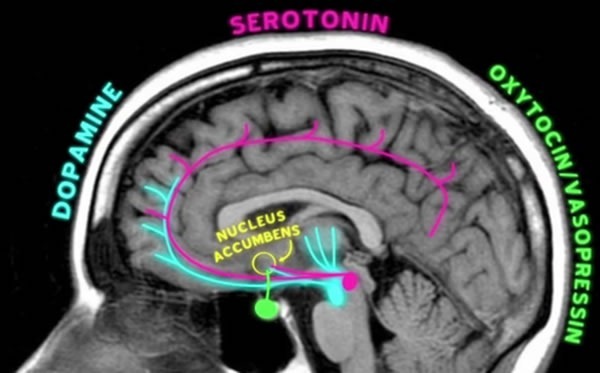
Third, I’m not sure how neuroscientists actually get to a point where they go, “yep, these are the love pathways“. The process of thinking love/ measuring thinking love/ ascertaining love areas/ getting someone else to think love/ measuring them against love areas- well, the whole thing seems like a self-fulfilling prophecy. What gets missed in this process?
Lastly, locating social concepts such as love in the brain can never end well. What if someone was put in the machine that could never produce any “love” activity- would we label them a sociopath? Does the woman crying at the end love her husband of 50 years less than he loves her?

Like Ron Burgundy reminds us, “You’re just a woman with a small brain. With a brain a third the size of ours. It’s science“.

It’s interesting to contrast The Love Competition with Hoff’s earlier work, The Crying Competition (don’t ask me why all these emotions have to involve competing, but whatever). In this, four men struggle so hard to produce a single teardrop that they quit after half an hour. When a woman sits down at the end, it takes just 20 seconds to deliver the salty goods. I think it’s easy to walk away from this video with a strong contention that men don’t [or can’t] cry. Certainly biological elements may factor into this (fluctuating levels of hormones certainly seem to make me tear up at some stages on the calendar). But what else might be going on?

Well, listening to the commentary from the men in the video almost seems to reveal an uncertainty about how to “get in touch” with emotions that lead to tears. I can’t help but wonder how much of this is a product of socialisation- a deep internalisation of the norm that men do not cry. But if we leave The Crying Competition video promulgating it as “proof” that men don’t cry, we perpetuate the very sentiment. 

I think that at the end of the day, what the Crying and Love competitions reveal, is that human expression about feelings is far more interesting than any scientific “measures” of emotion. One man in Crying even states that he is almost crying watching himself unable to cry- perhaps mourning the abstraction between masculinity and tears that his body has incorporated. Similarly, the disparate views expressed in Love reveal that there is a plethora of human experiences that we might call love.

The fact that the brain scans couldn’t adequately reflect these different experiences of “love” as relevant brain activity, shows us that such a neurochemical interpretation of love is flawed in the first place.

Just call me Twilight Sparkle: a word on bronies

From the "Friendship is Magic" TV series

I feel like the internet has been keeping a magical secret from me. A pop subculture revelation waiting in the (Fluttershy) wings. This gender bending gem is of course, the phenomenon otherwise known as bronies.

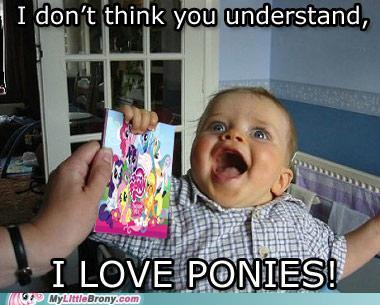
Another online miracle sprout of the infamous 4chan, the term “brony” (bronies is the plural) refers to adult guys that are massively into My Little Pony. Specifically, bronies revere the Friendship is Magic genre of MLP (an animated TV series), not so much the plastic ones I remember from childhood (which seemed slightly more demure, and a lot less like Powerpuff Girls). Some say that brony-dom is just another ironic fad, but then again, these fellas are pretty hardcore. They’ve even started holding “Bronycon“- a convention for dudes to share their love of the sparkly horses and magical unicorns (etc) of the show.

A brony in action

Bronies don’t seem to fit any stereotypical gender models- they embrace their proclivity for wearing the rainbow wigs and tribute wings of their favourite characters, while still donning their baggy jeans and gaming-related tees. And although some haters may label this “super gay“, the whole thing doesn’t seem aligned with any particular sexual orientation. There are even reports that a brony, upon finding a like-minded man, will fist-bump and say “bro-hoof!” with his compadre.

Apparently the appeal is the “non-combative fandom” and peaceful friendship story lines. In fact the Executive Producer of the series (up until recently) Lauren Faust (she is so cute BTW), is being hailed as some kind of pony queen/god. It seems to me that Faust is preeetty much the internet version of Judith Butler.

The only thing that worries me about this whole situation is that by all definitions, I am out of the brony club. Turns out women watchers of the show are dubbed “pegasisters“, which seems like 100% lamer if you ask me. I’m just not sure why in amongst all of the brony challenges to normative masculinity we have to get all gender-binary all over again. But there you go.

So let’s keep watching this web-wide fanboy wonder unfold- but I implore you, always challenge the broninormative gender assumptions you encounter.

The difficulty of speaking about “women”

I went to a Women of Letters event yesterday – a fantastic evening listening to some well-renowned women (including the fabulous Melanie Tait and Eva Cox) read out letters on the theme of re-writing history. After the letter-reading session, there was a panel on “divergent ways” hosted by Scissors, Paper, Pen of Canberra. But when one of the curators of Women of Letters, the talented Michaela McGuire (the other being the spunky  Marieke Hardy), was asked a question about letter-writing as gendered, I was surprised at her response. Michaela suggested that perhaps letter writing and the desire to express oneself with pen and paper (or computer and paper!) is more of an innately womanly pursuit. Furthermore, Michaela pointed out that yes, Women of Letters was made up of mostly “female” speakers.

Now, Michaela has stated in the past that she questions whether she calls herself a feminist or not, and has got some flack for running predominately woman-focused events. So given this acknowledgement I wouldn’t want to call Michaela out for her essentially essentialist statement on women. But it did remind me of the struggle that I often personally encounter with talking about “women” versus “men” as well as the problematic interchange I often make between the words “woman” and “female”.

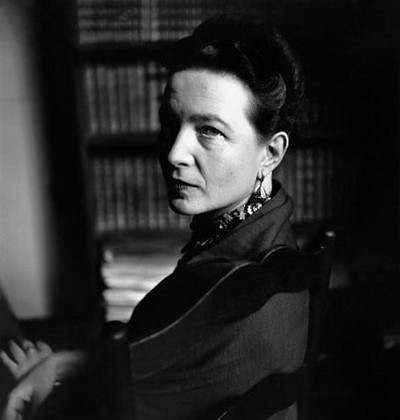
de Beauvoir: espouser of the sex/gender distinction

Simone de Beauvoir famously stated, “One is not born, but rather becomes, woman” (in the new translation by Constance Borde and Sheila Malovany-Chevalier). Following de Beauvoir, feminist writers have been keen to highlight the difference between sex and gender (of course not everyone sees it that way). On the surface of things, this argument amounts to the idea that sex is in reference to a determination male vs. female made at birth based on genitalia, while gender involves a process of acculturation, learning the expectations of what it means to be a “real” woman or a man (e.g. real men wear suits not dresses). Of course, then Judith Butler came along and posited that sex is caught up in a similar process, but that’s another story…

The point is that for the most part, much feminist writing has attempted to draw a very clear distinction between sex and gender- i.e. “female” and “woman” carry very different meanings. So while we might want to say that femaleness is biological (though this is questionable and hardly clear-cut as JB points out, and as intersex conditions demonstrate), the category of woman holds the weight of a history of socialisation involving certain gendered roles.

Then again, transgender/trans* came along and reminded us that there is a lot more to gender than just socialisation- some people desire transition from one sex and/or gender to another (or something in-between or outside of). PLUS trans* reminds us that gender isn’t just about masculinity or femininity- e.g. you can be assigned female at birth, become a man, but present as feminine (see Femme FTM). So what does it really mean when we say “woman”, “feminist” or we attempt to categorise what “women” are like? And doesn’t an awareness of the sex and gender distinction render attempts at answering any of these questions really really difficult?!

Academic and poet Denise Riley expresses her apprehension toward identity categorisations, reminding us that terms fluctuate in meaning over time and context. Nevertheless, Riley acknowledges, “While I can’t think why I’d want to utter that chilling phrase ‘speaking as a woman’, I can think of situations in which it could be my lot to cough pointedly from the back row, ‘But what about the women here?’” While I hold many concerns about using the term “feminist” (noting its tricky devotion to the gender binary), I still fill with rage, for example,  when I think about the under-representation of women in the philosophy discipline (see my philosophy women tumblr here, they do exist!- Did you know that a bunch of Pythagoras’ teachers were women? No? Well, they totally were!).

Toilet door symbols remind us that being a woman is about wearing triangle dresses

On so many recent occasions I have found myself struggling to express my feminist sentiments in non-essentialising ways. Certainly relying on the interchangeability of the terms “female” and “woman” is something I trip up on. When talking about even the most general things, such as the difference between dating men versus dating women, I am prone to making the most lurid generalisations that blur the line between sex, gender and “natural” traits. And, while I know I am guilty of this, I still cringe when I hear women speaking about their natural proclivities for sharing, being supportive and caring, etc. While we continue to promote these ideas about innate difference, we in fact produce them.

Are women more prone to letter writing? Maybe. But surely that is not something we are born with.

What a Bust: Sexy Dressing Revisited

Something funny happened to me this week. Bettina Arndt contacted a mailing list I am part of, asking for research related to an article she wanted to write on the way women dress. Arndt said she was interested in writing about the paradox that when women dress sexily they don’t necessarily appreciate men paying them attention. I didn’t think much of it. Being a PhD student, I hardly felt qualified to be giving advice. But later I came across what seemed a very relevant text – Duncan Kennedy’s Sexy Dressing – so I emailed it to Arndt, to which she replied with thanks.

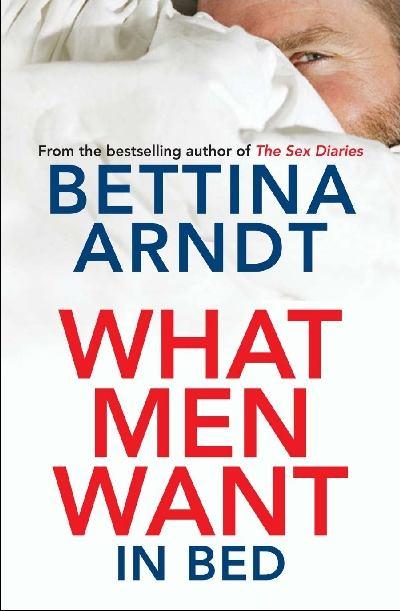
One of Arndt's controversial books

I then had a dawning realisation that Arndt isn’t just another academic, she’s that infamous and controversial sex therapist and columnist. I remembered where I had heard the name before – Arndt came to the Australian National University last June to promote her book What Men Want (spoiler: “more sex”), which was met with much protest from students. My inner feminista gave a little squirm.

But then, I thought about the content of Kennedy’s Sexy Dressing that I had emailed to Arndt (see also Kennedy’s Sexy Dressing, Etc). Written from a legal perspective, Kennedy asserts that there is power in women dressing provocatively, but promotes a sex-positive approach with an aim to reduce the sexual abuse experienced by some women that do dress sexily. Kennedy’s work has not gone down well with a number of feminist writers, given his endorsement of women’s eroticism for male heterosexual pleasure (see Janet Halley’s discussion of some reactions to Kennedy in Split Decisions). Basically Kennedy asserts that men have a stake in reducing sexual violence, abuse and crime, “so we can get on with playing within while evolving the [sexual fantasy] repertoire”. All in all I felt fine about sending this controversial sex- and desire-positive piece over, given that it so strongly asserts the need to differentiate between sexy dress/play and sexual abuse.

This morning I turned on the television to find Weekend Sunrise’s presenters discussing Arndt’s article “Busted: the politics of cleavage and a glance” appearing in today’s Sun-Herald (I wouldn’t normally watch this show, but I was waiting for PopAsia to come on, naturally). Arndt’s article basically frames women’s sexy dressing as a power often wielded unwittingly, that keeps men in “a state of sexual deprivation, dealing with constant rejection”.

Arndt's formula: women put it out there, men ogle

Unlike Kennedy, who frames his entire discussion around concerns of violence, Arndt only briefly touches on the issue, stating that “of course” men shouldn’t be sexually violent towards women because of the way they dress. The article paints women (especially the “young” women she refers to) as the naive commanders of sexuality, with sexual weaponry at their disposal (read: boobs). Men don’t fare any better, with Arndt stating that men are “lousy” at picking up on non-verbal cues in courtship (apparently all they see is boobs).

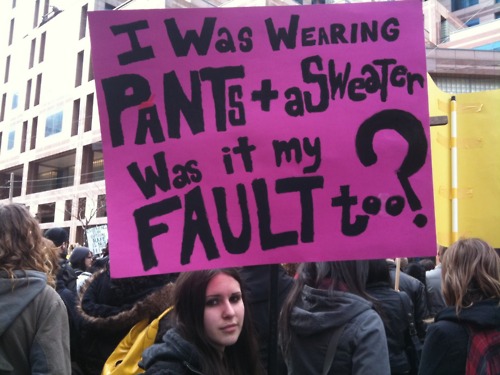
Aside from the binary-stereotype-reinforcements going on, there are so many problems that I have with this article that I can barely express them. Here’s a few: 1. It reinforces the idea that women are the only ones that put sex on display and that men are the only receptors of this (ignoring that men might also be negatively sexually objectified or that women might  be more than just “givers” of sexuality). 2. It doesn’t seem sex positive– rather than making some suggestions about how we might healthily negotiate the sexual power that Arndt accuses us of, she effectively condemns it, “with so many women now feeling absolutely entitled to dress as they like”. 3. It overlooks the many other directions sexuality might go in, not just orientation-wise (women can find women sexy too), but issues of domination and how these might figure in conversations about sexual power are not discussed.

An image from Chicago's SlutWalk

4. Last but not least, it only vaguely considers sexual violence and really does seem to suggest that women “invite” attention through the way they dress- yet I get wolf whistled at by men even when I’m dressed in tracky dacks and a baggy old t-shirt, it’s disgusting and I hate it!

I am deeply disheartened by this article, and can only hope that it invites greater discussion about sexy dressing in a way that moves beyond the simple and sensationalist stereotypes that Arndt presents.

What Disney Princesses taught me

I came across this today-

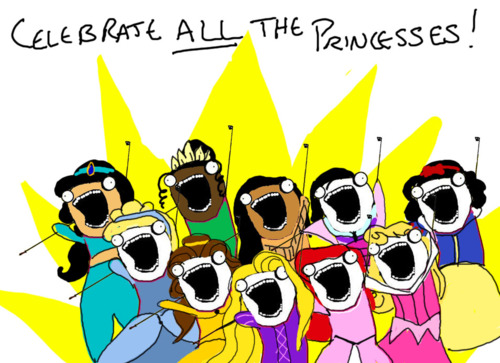
A reading of what Disney princesses teach girls

Sure, I have considered the rather un-feminist implications of a lot of the princess story lines before. But I’ve never really sat down and thought about it. My reaction to this picture was to think that I could see how these readings were plausible, but that for me, reinforcing hetero-norms is not the first thing I think of when I see the princesses (which is odd, cos that’s basically all I see in everything).

Okay, on the surface they all want their prince to come, etc, etc. And they’re all feminine and beautiful, and fairly non-diverse (until Princess Jasmine, Pocahontas, Mulan and Tia cracked the scene). While I distinctly remember adoring little mermaid Ariel growing up, my mum loved Ursula, and was pointed to note that not all short-haired plump women were actually sea witches. Looking at the older princesses (Snow White, Sleeping Beauty, and Cinderella) compared to the newer ones, there is a marked difference between their representations. Princesses have had a lot more ‘tude since the 1980s.

Totally.

I went back and watched Colours of the Wind from Pocahontas. It reminded me that, wait a minute, these chicks kicked ass in these movies. The prince thing was always just a distracting part of the story line for me, and I barely remember the prince characters. While the princes were all pretty generic (charming, rich, handsome…*yawn*), the princesses had exciting lives, amazing magical friends and, most of all, adventurous spirits. But, I guess that’s why it’s kind of depressing when they all end up “settling down” in the end.

No doubt, you could write a feminist tome deconstructing these animations (I’m sure they’re out there). Still, I can’t help looking back fondly at the Disney Princesses I grew up with. And I’m really not waiting around for my prince to come. Why? Sorry, too busy exploring the shore above, painting with the colours of the wind – I want much more than this provincial life, I want adventure in the great wide somewhere….

Total synthesis and the cult of the natural

"Unaltered" food is a big selling point

Yesterday, I got into a discussion about genetically modified crops. My perspective was that while one might have ethical concerns about the practices of companies such as Monsanto, this is different from having an issue with genetic modification (GM) itself. This apparent blurring of lines between the science of GM and the corporatisation of GM products was most clearly evidenced in July 2011, when Greenpeace activists whipper-snipped a GM field trial in Canberra. Despite CSIRO publicly stating that they have no known links to Monsanto, Greenpeace defended their actions on the basis of possible dangers to humans.

But it seems to me that there is a fear underlying the GM debate that is about more than concerns for human health. In a time when many people are anxious over the future fate of the planet,  it seems we’ve also developed a fetish for the natural. On the surface of things, this doesn’t sound bad. In fact, words that might spring to mind when we think of “natural” include healthy, normal, organic, green and well being, not to mention those mental images of makeup-less women standing under waterfalls in luscious rainforests. This is probably somewhat due to the plethora of advertisements that claim their products are good for you because they are “100% natural“. Ironically, by definition something can be deemed all-natural, even if produced through an entirely synthetic process (chemical synthesis of organic molecules).

But chemicals aside, how can we ever grasp a rigid definition of the natural?

Railing against the purportedly unnatural is often brought up in arguments against bodily modification such as plastic surgery, including sex affirmation surgery. In these debates, surgery is posited as a mutilative act. Apart from the religious idea that the “body is a temple“, I’m not sure where this idea of the sanctity of the body comes from. We alter our bodies and appearance on a daily basis- we put makeup on, we cut our hair, we wear different clothes, do or don’t exercise, eat different foods, pierce our ears, or even put coloured contacts in our eyes. While these effects may not be as skin deep as surgery (with tattooing as a modificatory middle-ground), our appearance and the way that we intentionally shape it are an important part of who we are in the world- who we show ourselves to be, for others to perceive.

Corsets: body modification back in the day

The differences between GM soybean crops and having a mastectomy for sex affirmation are obviously very very vast.  Some people may have radically different opinions about GM versus surgery. Granted, there are also ethical considerations to be made on these subjects that warrant discussion. However, I think that public reactions to these issues often reveal deep-seated sentiments about what is natural (and whether that is good), which need to be acknowledged as separate biases.

One day I imagine that we will be able to grow our own spare body parts, making modifications all that much easier. And perhaps by definition, through this act of synthesis we will consider it natural…

What’s with all the fat hate of late?

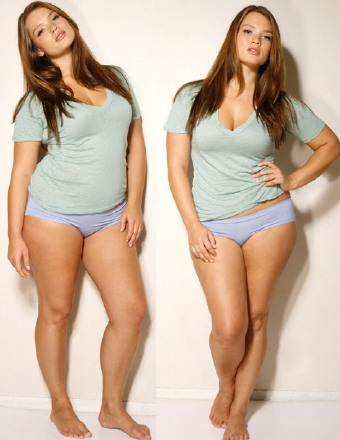
Tara Lynn- a so called "plus-sized model"- reminding us that on some women thighs are allowed to be bigger than ankles!

Currently on Australian television, there are at least two anti-fat (fatphobic?) shows screening. Sure, this kind of thing has been around for years. But amazingly, they seem to be reaching new lows on the encouraging body-hate front. Yes, this year’s Biggest Loser program (as if it isn’t bad enough that they make everyone’s stated aim to be a “loser”), is all about the “singles”. That is, those people who supposedly can’t get a date because of their weight (cos like, no one wants to date a fattie right?).

Since when did being weighty make you unloveable? It seems like a lot of the people on these shows have major self esteem problems, that actually probably go hand in hand with their weight gain due to some other reason. But rather than dealing with those kind of underlying factors, the aim of the game is to lose lose lose and be a normal skinny person – hooray! And rather than getting fit and stopping at some still full and voluptuous weight, these people are encouraged to keep going until they practically fade away. And I’m pretty sure that for most people, a “normal” weight range (whatever that means) is actually pretty vast. I downloaded an app the other day that told me I could literally put on another 20 kilos and still be a “healthy” weight.

It turns out these TV shows sure ain’t the only fat-hate going down at the moment. The recent Strong4life campaign being run in Georgia USA has been advertising a serious war on children’s weight. Apparently you can’t actually be a kid now if you’re fat- as one Strong4life tagline tells us, “being fat takes the fun out of being a kid.” This argument reminds me of the whole “we have to correct intersex conditions or those kids will be incessantly teased”. It seems to me like when we run campaigns that say what’s okay and what’s not okay, or perform surgeries to reinforce what is “normal”, well, actually that’s bullying- through defining what is normal in the first place.

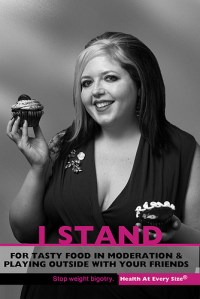
Queer fat femme standing against weight-hate. She's pretty much the bestest femme ever. Check her out at queerfatfemme.com

Somewhat hearteningly, there has been a backlash against Strong4life called “Stand4kids” (not to be confused with the terrifying missionary group of the same name) which aims to target weight bigotry (you can join them on Facebook here).

When it comes down to fat-hating TV (and lets be honest, most of the film and television industry is pro-skinny), I think we have to take a hard look at ourselves and ask where the enjoyment for these shows comes from. Maybe it’s interesting to watch before and after journeys. Maybe it’s that we want to watch people struggling to exercise and eat well, just like we all do. Or, maybe it’s just that we want to watch some “freaks” get tortured and shamed for being “different”. Oh dear.

But the more I look around me, the more I notice curvy chicks oozing confidence and being proud of their bodies. And why shouldn’t they be. What I wouldn’t give for some cleavage…