Jack and Jill: Why Adam Sandler fails at life


EPIC (gender) FAIL

With a Rotten Tomatoes rating of 4% (“Jack and Jill is impossible to recommend on any level whatsoever”) and a Rolling Stones review of zero stars (“A total bust, a stupefyingly unfunny and shamelessly lazy farce”) it’s a wonder anyone would ever pay to see this movie.

I for one, will not.

Now, I understand that some people might say, “don’t knock it till you try it”. Well people, I tried the trailer.  And if I went to see the movie after that experience, it would kind of be like tasting some poisonous red berries and vomiting, and then following that up by make a poisonous berry jam cake and eating that too. It just wouldn’t be a good idea.

Mainly, what’s not okay about this film is that Sandler has made the FUNDAMENTAL ERROR of making “easy comedy” out of gender (that is, him acting like a “woman”). It’s not cool Sandler. See Juliet Jacques’ fantastic article for New Statesman on why this kind of comedy is not only degrading, but just generally not funny. On the one hand I appreciate the South Park philosophy of humour that it’s okay to make fun of anything– so long as you don’t leave anyone out. On the other, I don’t see that there are enough positive representations of gender-bending in popular culture to really balance the kind of poor humour presented by Sandler’s new flick.

Entertainment Weekly might laud Sandler for his ability to make people pay to watch him despite being incredibly crap, but I say bring on the boycott.
Sydney [née Gay and Lesbian] Mardi Gras: Really?


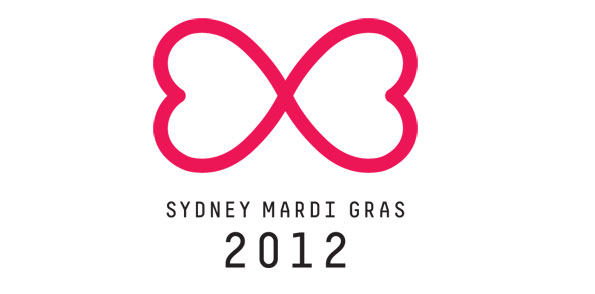
The new "Mardi Gras" logo: I smell a heteronorm

There is some disenchantment within GLBTQIQ communities over the 2012 Sydney Gay and Lesbian Mardi Gras’ attempt to be “inclusive”. There has been some media coverage of the issue and  you can join the Occupy Mardi Gras Facebook group here. Some are questioning the step toward heterosexual assimilation inclusion that the organisers have now cemented through the re-naming (read their justification here). The Mardi Gras has a history of discrimination within GLBTQIQ ranks. The name “Gay and Lesbian Mardi Gras” never really captured the alphabet soup (and admittedly, neither does the acronym that I am using here), and it wasn’t long ago that the likes of trans, bisexual and intersex people had to pass a “gay threshold” just to come to the after party. However, the new name change does nothing to embrace plurality as such- as some commentators have pointed out, why not put “Pride” at the front of the Mardi Gras title?

What I find most off-putting about the current re-branding shenanigan is the new symbol that has been chosen (to replace sit alongside the iconic opera-house-esque logo before it), which to me, REEKS of something like this —>

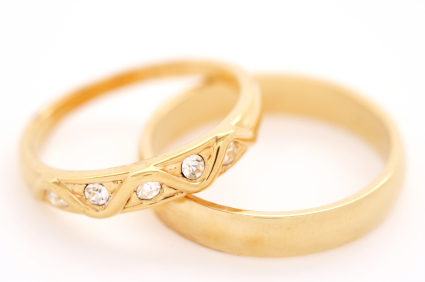
The new "Eternity" vision for Sydney: let's all move to the 'burbs shall we?

Don’t get me wrong- I’m all for “Gay” Marriage, but I’m also for embracing polyamory and other pursuits – which warrant inclusivity in the Mardi Gras celebration – that are not at all captured by the new sterile and clean cut graphic. Polyamorous people might even agree that their widely used symbol has been parodied and given a whole new meaning.The new “infinity hearts” reminds us of tiered cakes, string quartets and the bridal march- where are the whips, orgies and all manner of queer fantasy machines in that?

Pansexuality: because bisexuality is so passé?

Pansexuals strike back

When I talk to people about gender and sexuality, a lot of people tell me that they “don’t fit into any category of sexuality”. Then I tell them about pansexuality, and I usually get an “oh, right. That’s what I am”.

Pansexuality describes a sexual orientation wherein a person has the ability to be attracted to a diverse range of people across sex and gender spectrums. Pansexuals describe their attraction as different from bisexuality, which only considers the gender binary- if you are bisexual, by definition you are attracted to either men or women. Thus it is often claimed that pansexuals are “gender blind” (though some pansexuals would argue that this is not the case- sex and gender may play a role in attraction, but their sexual orientation doesn’t rule anybody out because of their sex or gender presentation).

While academia seems to be running to catch up, some of the most interesting perspectives on pansexuality come from YouTube posts like this. What seems startlingly obvious about the presence of pansexual self-proclaimers on the internet, is their age. While I’m sure that with the evolution of the term into more popular usage there will be more and more people of all ages that adopt the category to describe their own orientation – but for now, it seems that (overwhelmingly) Generation Z is embracing the idea.

The pan flag

It will be interesting to see how this identity discourse will pan out. What effect will pansexuality as an accepted and well known sexual orientation have on our views on sexuality’s relationship with the gender binary in the first place?

What’s great about pansexuality is that it allows a new way of thinking about desire and love, that is (apparently) outside of gender. Though, I do find the pansexuality vs bisexuality debate a little concerning (our sexuality is better than your sexuality- really?). Admittedly there are both those asserting their pansexuality and those reclaiming bisexuality in the face of the new pansexual discourse.

After all, I can’t help but wonder whether some people currently identifying as bisexual meant something closer to pansexual all along?