Worried about your body? Join the club.

I haven’t always had a super happy relationship with my body, but it’s only been the last little while that I’ve really started to care properly about my weight. And when I say properly I mean, get obsessive.

In high school I was too distracted with worries about my ubiquitous dark body hair and small bust to think much about weight. My genetic predisposition/height/beach lifestyle/youth meant that I ate crap-tonnes of chips and never really worried about my midsection. Plus my mum raised me with an extremely good ethic of “love who you are“, and never spoke about dieting or an obsession with losing weight herself. When I got to uni, I would prance around in teeny shorts, still revelling in my 19-year-old metabolism. But I remember the day I started caring. I was 21, and I looked in the mirror at my bum and though, “Oh, right. Shit.” That moment didn’t really alter my eating or exercising behaviour much, though I did start covering up more. Mostly all I got was an unhealthy dose of body-angst.

I’ve always been someone who rejects “diets” and been the first to tell my friends who are trying to lose weight that they are crazy and don’t actually need to change a thing. Now I’m 26 and I’m not sure what triggered it in the last month or two, but I started to pay attention to my body a lot more. I decided I would try and take control of my eating and exercising. As soon as I started “calorie counting” and swapping hot chocolates for tea, and pasta for mountain wraps, I became a lot more aware of just how starving some people (especially famous people) must actually be. I’ve been trying to eat “well” and exercise a significant amount, but it makes me wonder- heck those famous people must be eating air to stay as thin as they are. And damn, they must be cranky!

It turns out yes, Jennifer Aniston for one is rumoured to have eaten the same salad for her entire decade on Friends. Just one type of salad. For 10 years!

I’m not on a crazy one-salad diet, but in the last month or so I have changed my eating habits, lost some weight and toned up a bit. But I’ve also become fairly obsessed about food and how I look, and that sure seems like a bung trade-off. I think I was lucky to have escaped the weight game for so long. Though I agree that magazines perpetuate unhealthy stereotypes of bodies, I don’t think you can just “blame the media“. These kind of critiques flatten our understanding of how ideas of what is “normal” perpetuate in society, and I hate to say it, but I think most of the time it comes down to ourselves – we are effectively policing each other’s bodies, every day.
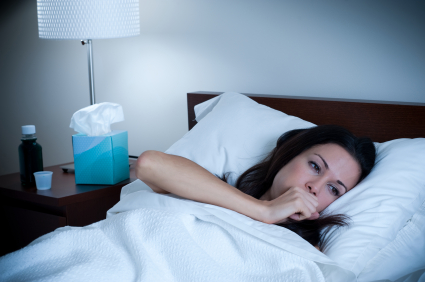
“Well, at least this debilitating illness is making me thinner….”

Example 1: You comment to someone, “oh, have you lost weight?”. They might immediately feel self-conscious that you have been silently judging their weight in the first place (“you thought I was fat before?!”) while simultaneously proud that they look thinner (and who knows, maybe they’ve lost weight because they have swine flu…)

Example 2: You complain to someone that you feel “so fat” and are trying to lose weight or are on a diet. This often comes up when you are buying/eating food together. The other person might immediately feel guilty for not doing the same act of abnegation.

Example 3: You judge the crap out of your own body. If you get in a judgey state of mind, there is no way that you are not judging everyone around you and comparing yourself to them. It’s a negative cycle with all roads leading to judge town, population: you.

Then of course, there are the overt examples of you or others blatantly commenting on weight or size, “you could exercise more”, “you are too skinny”, etc etc (or my personal favourite: I bought a packet of Oreos to a work meeting, and one of my colleagues told me I should “watch [my] arms”). If we simply blame the media, we miss the fact that we open up Vogue and condemn the lack of diverse bodies on the one hand, and then all secretly download calorie counting apps and don’t have a tim-tam when it comes to afternoon tea, on the other. We are promulgating the issue, just by the fact that we don’t acknowledge just how much we are really judging ourselves.

There’s obviously no simple remedy to this (except maybe watching a local Roller Derby game to remember that kicking-ass comes in all shapes and sizes). But perhaps, if we can’t stop judging ourselves – and by that standard others – maybe we can at least admit that we are. We need to think: when we are watching weight, is that all that we are really watching?

 

Why being “born this way” shouldn’t matter

“If you don’t have any shadows, you’re not in the light” – LG

In 2011 Lady Gaga wrote a song that has become a bit on an anthem for the LGBT movement. Though Madonna would like to point out that she helped with the tune, Born This Way is a pretty amazing song for using and normalising terms like bisexual and transgender within a popular realm (plus just generally encouraging the listener to feel empowered). It seems that in this song Gaga is promoting the political line that people should be respected because their attributes are predetermined.

Don’t get me wrong, I think that this is a valuable sentiment and has certainly been a central argument for LGBT activists for some time now. There are already a number of people out there writing about how we aren’t “born” but rather “made” (i.e. socialised into being) and I’m not here to make that contention. My problem isn’t so much with the idea itself, but why we need to make it in the first place.

I just don’t think we should have to argue that someone was genetically pre-determined to be XYZ, in order to accept them as the human being that they are. It just seems silly. Plus this line of reasoning inevitably leads to lynch-mobbing as soon as one LGBT activist says, “well, actually I personally don’t feel I was born this way” (see the Cynthia Nixon debacle). Admittedly the biggest factor beind the born-this-way line of reasoning is probably that it is a reaction to the crazy bucketloads of homophobia and hatred based on the notion that being gay is “immoral” or “unnatural”. And who wouldn’t react to such violent exclusion with an argument that says, I can’t help it, it’s science.

But if we keep trying to win all of our arguments on the basis that it’s science, what happens if one day (some how) they “prove” that sexuality isn’t pre-determined? What then? Do we just chuck out all of our politics? If this ever happened, one way to turn it around would be to say… “so I guess being born ‘straight’ isn’t a thing either…?” And the whole question of the natural versus the unnatural would be turned on its head.

At the end of the day, people should be respected as the human beings that they are. Full stop.

Because life ends at marriage?

Everyone loves a good wedding (BBC’s Pride and Prejudice)

I went to the movies this evening and saw what was a funny but pretty middle of the road comedy. I don’t want to give away any spoilers, but let’s just say it was your normal Hollywood light entertainment piece (*talking bear cough*). The film was actually quite enjoyable, but had the most predictable and un-funny ending ever. You guessed it, a wedding.

I left the theatre wondering why it is that we don’t seem to be able to get past this neat little plot device. Maybe it’s just the easiest way to spell out “all’s well that ends well”. After all, Shakespeare’s comedies always finished with giant group weddings and frivolity. But you’d think that in this era of increasing divorce rates, surely we’d be imagining some alternate models for spelling out happiness? Much like the beloved Bechdel test, I feel like we need a rating system for romantic comedies that don’t equate true love with a wedding fest.

But then, when I tried to think of romantic comedies that did (or didn’t) end in weddings, I could only think of the most obvious ones – The Wedding Singer, Four Weddings and a Funeral, My Best Friend’s Wedding, Bridesmaids

From Miranda July’s ‘The Future’

Then I came across this excellent list of romcoms that are not your typical Hollywood fare but have done well nonetheless, and there’s not that much weddingery in sight. Films listed include Eternal Sunshine of the Spotless MindVicki Cristina BarcelonaBefore Sunset… But what’s interesting about many of the pics on this list is that the “happy factor” at the end is debatable. Most of them have a sense of hope mixed with bittersweet realism and often just plain old sadness and loss.

In the end I say give me emotional realism over fantasy wedding bonanzas any day. I’d rather leave the cinema feeling a little heartbroken, than walk away and forget the film in much the same way that one passes apple juice- quickly and with little to digest.

Femme Flagging II: The Glitter Strikes Back

So a little while ago, I did a post on the difficulties of being recognised as a femme. One of the difficulties with identifying with femme is that you have to come out over and over again because people assume that you are doing the heteronormative thang. As blogger Megan Evans points out, “we mainly slip under the radars of both gay and straight people”. Visibility matters. Though I have to say, Evans’ online campaign for femme visibility is kind of dispiriting since it is only for “those who define solely as lesbian” (where’d I put that pack of gold stars…). But homo-normative femme campaigns aside, how do you let the world know that you’re a [queer/gay/pansexual/lesbian/straight/kinky/bisexual/insert-identifier-here] femme?

Having a go at some femme flagging of my own

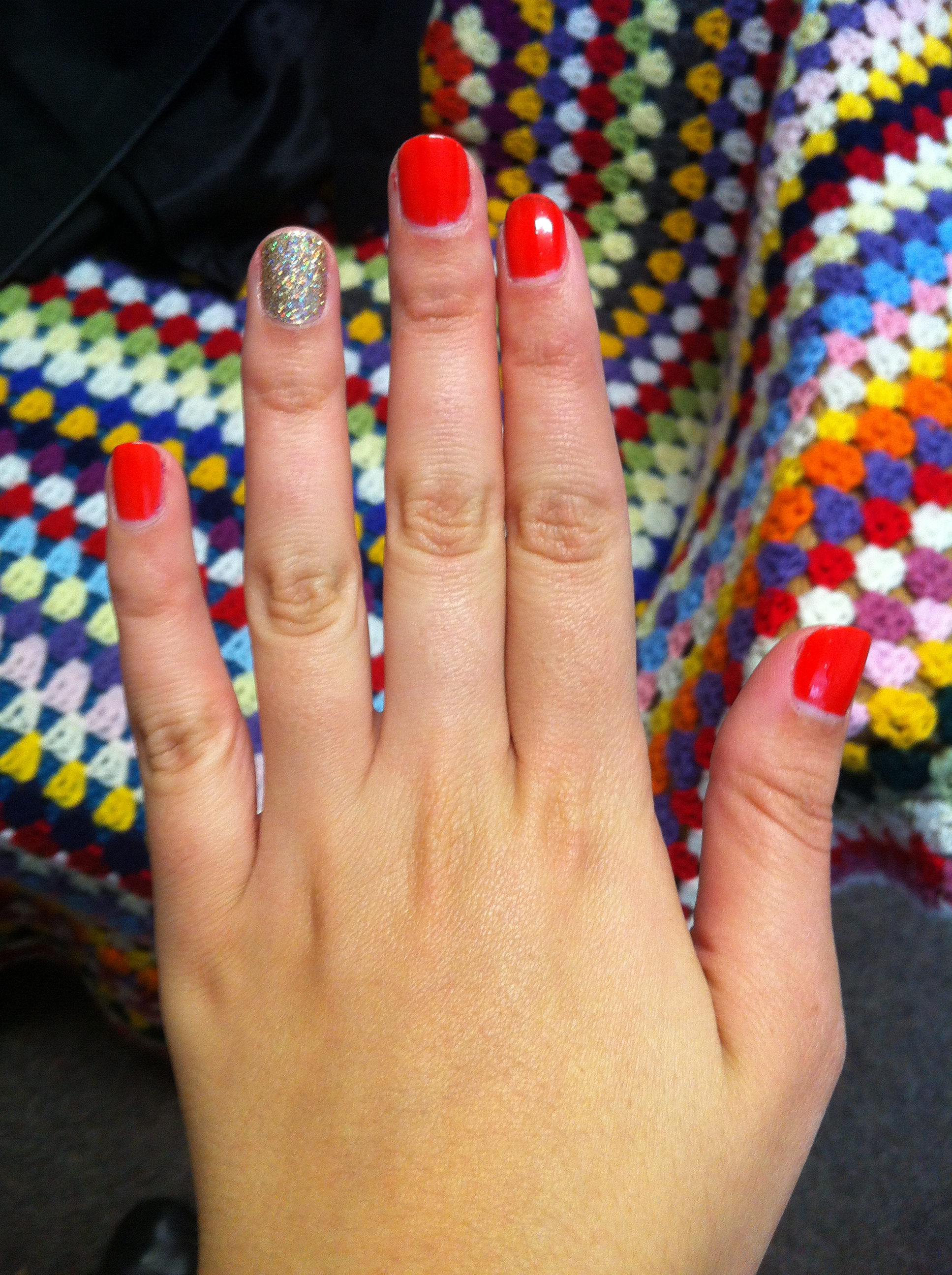
Nail polish. I feel naked without it. So you can imagine my JOY when I read this post about femme flagging using the stuff, on the Queer Fat Femme blog. The whole “flagging” thing is meant to be a sexual code that lets your prospective partners know what you are into, and was traditionally practiced with strategically coloured hankies in your back pocket (e.g. fuchsia worn on the left means you’re more of a spanker than a spankee). There’s a pretty elaborate guide to the whole hanky code available here.

But aside from pronouncing your sexual proclivities, it seems that the new femme code of painting one fingernail differently to the rest is more about signaling general femme-ness than anything else. Apparently it all started in March this year, when someone on Tumblr suggested the idea after posting this picture and suggesting that fingernails were the perfect femme version of the hanky code (it’s like Starbucks invented femme flagging…is this just an elaborate marketing campaign?). I have to admit that I got pretty carried away when I first heard about it, as did several femme groups I’m part of online. There was a sense of finally, we can recognise each other! in the air. Though of course we can assume that not all femmes like wearing nail polish, it seemed like a pretty fabulous idea.

SDB sporting some femme fingernails and looking overall pretty femme fabulous. SDB if you’re listening, I think you’re an accidental femme icon

But then, things got tricky. Someone in our local femme group noticed that a contestant Sarah De Bono on the Australian reality singing show The Voice, had been sporting the look. I immediately got on to Twitter to try and contact her, to see if she had done this intentionally. I said I would “vote” for her if I got an answer. An obsessed fan wrote back – nup, SDB is not a flagging femme, she’s just being trendy. This was a double-blow. Not only had SDB appropriated this newly found queer indicator, but I also had to stick to my word and vote for her.

Springsteen: Fist receiver?

Back to the drawing board I thought  *sigh*… BUT THEN I remembered that good old Bruce Springsteen album, the one where he accidentally flagged the hanky code for fisting! I also reflected on the fact that a lot of the time mainstream culture absorbs awesome stuff from the queer community, because it is awesome (e.g. who doesn’t like rainbows?!). And despite Born in The USA, flagging persisted. So why not finger nails too? I’ve decided: I’m going to persist with the nail polish thing. Though I’ll be aware that not all femmes are going to paint their sexuality on their hands and not every person I see with trendy nails is a femmster. Hanky code or no hanky code, I am going to keep hoisting the femme flag, loud, and glittery proud.

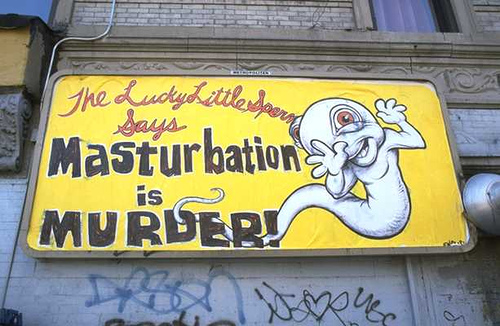
Masturbation: More Like Masturgaytion?

So I was reading some philosophy the other day – by one of those crazy French guys who’s writing is so dense you need a chisel to get through – and it got me thinking about touch. The piece was The Intertwining–the Chiasm by Merleau-Ponty, which focuses in part on the concept of one’s own hand touching the other. Merleau-Ponty uses this example to explore sensation and perception as a two-way process. Just as your hand feels, it is also being felt. It’s fascinating and poetic stuff and since Merleau-Ponty died before finishing this remarkable essay we are only left wondering where he was actually going (however my sense is that even if he’d finished it, I’d still be pretty lost). Thinking about all this touching and being felt this question popped into my mind: is masturbation inherently gay?

I’m not the only one who’s been asking this. Last year, Pastor Mark Driscoll from Seattle made some strong remarks against men engaging in solo fun unless a lady friend was also in very close vicinity. Driscoll also made the claim that masturbation is “monosexual” and particularly sinful if a man is, “watching himself in a mirror and being turned on by his own male body”.

Incurring the wrath of God aside, what else can we say about this touching-oneself experience when it comes to desire? I’m guessing that not everyone sits in front of the mirror checking themselves out, but in fact fantasizes or watches porn, etc. So are we just touching ourselves but imagining that the “toucher” is actually someone else? One might draw the conclusion that this explains why so many men watch porn, i.e. MUST-SEE-WOMAN-ON-SCREEN-SO-NOT-GAY. However, since women are also avid porn-watchers, perhaps that’s an unfair conclusion. Plus, as previously discussed, I’m not a big fan of drawing gendered lines in the sand when it comes to talking about what men or women “normally” do. And who is to say that our porn watching habits actually reveal anything about our sexual orientation? Perhaps gay men masturbate to female porn?

Well, I don’t know about gay men, but there has been a fair bit written on lesbians that watch gay male porn. Apparently (according to writer Ariel Levy) “It’s definitely a thing”. As this piece from The Daily Beast explores, a lot of women report that watching gay porn is about enjoying masculine role-play and themes of domination and power more than gender per se. The article quotes comedian Kate Clinton, explaining her proclivity for man-on-man visuals: “We’re so used to watching men in our lives wield power. Gay porn is an opportunity to watch them get f—–.” Clearly the porn that people enjoy has an elaborate relationship to the desires that people have. 

Considering all of these points, what are we left with when it comes to beating the bishop/ cranking the shank/ jerking the gherkin/ insert euphemism here? Well, at the end of the day I don’t think that masturbation is inherently gay because it involves the mind and not just sensation. Considering this particular experience of touching and being touched reminds us that desire is not so black and white, in fact, it is extremely complex.

Babyz in the Hood: Girlhood Aspirations Then and Now

Yesterday I came across this amazing song from the Muppet Babies circa 1984:

I had a dawning realisation that 1984 is getting to be quite a long time ago now (*gasp*) and that the kids that would have watched Muppet Babies would already be in their mid to late thirties. With this in mind, I started to think: do the lyrics of the song give us some insight into girls’ childhood aspirations of the time, and, are these aspirations playing out in the lives of the thirty somethings as we speak?

Baby Miss Piggy sings: I’m gonna be a movie star/ And I’m gonna learn to drive a car/ Gonna be a veterinarian too/ And I’m gonna always love you/ I’ll be the cutest model you ever saw/ Then I think I’ll study criminal law/ And I’m gonna scuba dive too/ And I’m gonna always love you/ I’ll be a doctor for diseases/ And help you with your sneezes/ And practice neurosurgery on your brain!/ Gonna climb the Matterhorn/ But only after all our children are born/ ‘Cause I want to be a good mommy too! / And I’m gonna always love you!

The song conveys the idea that baby Miss Piggy aspires to be good looking, outgoing, have children and a successful career. I couldn’t help being reminded of all of the contemporary writing on the “problem” of the modern woman that thinks she can have it all. There’s a lot of writing on it, so I won’t go into the debate here. Suffice to say that my take on it is that perhaps we need to focus more on supporting shared parenting responsibilities and part-time work arrangements rather than arguing either that: women should be and do everything OR that women should simply choose. While I’m not sure that Muppet Babies are to blame for this particular issue, it did get me wondering what kind of girlhood aspirations are currently being represented on television.

Then I came across this (I suggest only watching two minutes maximum, it is quite painful):

This clip is care of the Bratz Babyz film 2006. The lyrics for the song at the beginning of this are: Put on your makeup/ Fix your hair/ No time to take up deciding what to wear/ It’s now or never/ You can’t slow down/ Gotta get it together/ Cos time is running out/ Final count down/ Get ready now/ 5, 4, 3, 2, 1/ Gotta be hotter than hot/ You just have to rock/ No time to stop/ ready or not/ Gotta look hotter than hot/ Gotta show what you got/ No more time on the clock/ Ready or not

As the lyrics and visuals reveal, girlhood aspirations portrayed in Bratz are heavily tied up with wearing makeup and overcoming the burden of choice, that is, what colour dress to wear (!) Amazingly, the characters in the clip shown are babies, not full grown “Bratz”. The baby Bratz world reveals that even toddlers are concerned with matching their lipstick with their outfit. Now, I don’t want to get all down on femininity. I love lipstick. I do. But babies concerned with being “hotter than hot”? I have to admit this is slightly concerning. Not least because it infuses a focus on consumption even further into childhood. As a member of society well and truly down that rabbit hole, I would only hope that people in their younger years could put this off as long as possible.

A girl showing her Bratz inspired face paint

But aside from capitalist concerns, it also seems to flatten aspirations- sure, baby Miss Piggy wanted to be a hot model, but she wanted to perform neurosurgery on your brain too! On the other hand, while some may say it is precisely toys such as Bratz dolls that contribute to the media’s sexualisation of children, the Bratz movie also reveals an abstraction of femininity from sexuality. No longer is femininity about being a perfect woman for a man, it’s just about indulging in femininity, pure and simple…

By my calculations (considering that the Bratz range came out in 2001), the Bratz generation should be in their mid-late teens/ early twenties by now. In the end, what future do these lyrics foretell for the up and coming generation of women? How will they differ from the Muppet Babies generation before them? Only time will tell…

Darth Penis vs. The Training of Men

Ok, so it may seem like a silly task to dissect a flippant popular culture article (although, that is mostly what is done on this blog). However, I got some referrals to this cracked.com article today titled, ‘5 Ways Modern Men Are Trained to Hate Women‘, and by popular demand, thought I would give a considered response. Incase you can’t be bothered looking at the article, here’s the five basic tenets of its argument:

– Boys are indoctrinated with the idea that one day they will be “rewarded” for their efforts in life, with a hot chick. When this doesn’t work out in life, this makes men inevitably turn into the Hulk (that is to say, angry, not giant and green)

– Boys learn that women must always be pretty and decorative eye-candy. They can have a brain/be people too, but they also (mostly) have to be hot. Again, when this is not the case, HULK SMASH

– Men have penises that they can’t help touching (e.g. in public places), they are super horny creatures that just want to get laid 24/7. So when a girl “shows too much skin” this is a major tease, which brings out the big, green, angry man

– Men think that since childhood, women have gradually emasculated their “core male urges” (e.g. stopped them from showing their penis to strangers as a child). This makes men embarrassed and spiteful

– Men are OBSESSED with sex. That is why men have created civilization. To get the hot chicks. The hot chicks which they actually, will probably not get. The hot chicks who they will not get, who show too much skin, and have emasculated them. This all causes resentment and a BUCKET LOAD OF ANGER. HUUUULK

All in all this article reads as a kind of feminist take on why men subordinate women. To be fair, I think that this article is well-intentioned, and has mostly come about in response to the truly misogynous comments made by Rush Limbaugh in the USA recently. However, there are some very, very concerning assumptions made in it, that should be pointed out. The main problem with this article is that it reinforces some pretty serious stereotypes about men and women, even though it is actually trying to challenge some of them. How’s that? Well…

In some respects, this article presents a blurred line between the “constructed” and the “real”. While the article is keen to preach the things that men are “taught”, is also relies on a bunch of statements about men’s “nature”. So while men’s thoughts about being owed sexy women is something that they have learnt, they have an anger-response and ridiculous sex drive that is intrinsic to being a man. The proof in this “base-urge” pudding is given as neuroscience findings, possibly higher testosterone levels in men, evolutionary factors, and/or “maybe society has trained us to be like this”. Despite this little construction-disclaimer (we learned to have these crazy base urges), the article still paints this as a kind of man-truth.

The article actually gets close to questioning the naturalness of the “man” category in point #2, recognising the kind of enforcements of male masculinity often seen in popular culture, but then goes back to talking about how when men are boys “Darth Penis” rules their primal urges to wave their wang in the face of women. So, in all of these senses, this article actually reifies what men are like, in the way in which it talks about the “nature of men”.

Most problematically, when we get to point #1 of the article, that men have constructed civilization to get some lady lovin’, but will forever remain bitter and twisted about it, I can’t help thinking of this:

"I have turned the world upside down"

In the end, I think it’s great to have discussion about what we absorb from the gender norms perpetuated in society- it’s just a shame that often in our questioning, we end up reinforcing the idea that “men” and “women” are discrete and stable categorical realities, and we end up driving that gender binary wedge just a little deeper.

Men, and International Women’s Day

Today I went to a luncheon for International Women’s Day (IWD). The room was full of hundreds of (mostly) women, from many different sectors in the community. Being there, listening to speakers on the topic of “women” (mostly focusing on the need to enhance the lives of women in developing nations), I had some deep pangs of uncertainty. As I sat there, eating my posh lunch and sipping Pinot Grigio, I couldn’t help but ask myself, what does it even mean to be a woman? Should I be proud? What does it mean to be an “empowered” woman? Where do men figure into this?…

It felt to me like the “feminist” bent of the meet was to say “look, there’s still work to be done sisterhood, keep up the good fight!”. Not a single speech considered the relevance of feminism or the importance of challenging gendered assumptions. But I was torn – while I sat there wishing we could instead have an “International Question-the-Binary Day”, I was also struck by the fact that the lived experience of many women around the world is profoundly disturbing and must be addressed (and, admittedly many women in need may not be helped much by my proposed academic gender-deconstruction talk-fest). I think that some of my existential angst sprung from the fact that I felt a deep concern over my relationship to the women overseas being spoken about, considering my apparent academic Western ivory tower.

Though I didn’t quite come to terms with these cultural qualms, I was also still stuck on the issue of the day being so overtly gendered. The old adage often brought up on this day is, “why isn’t there an International Men’s Day?” with the reply “every day is International Men’s Day!” This oft quoted interlude is problematic for several reasons:

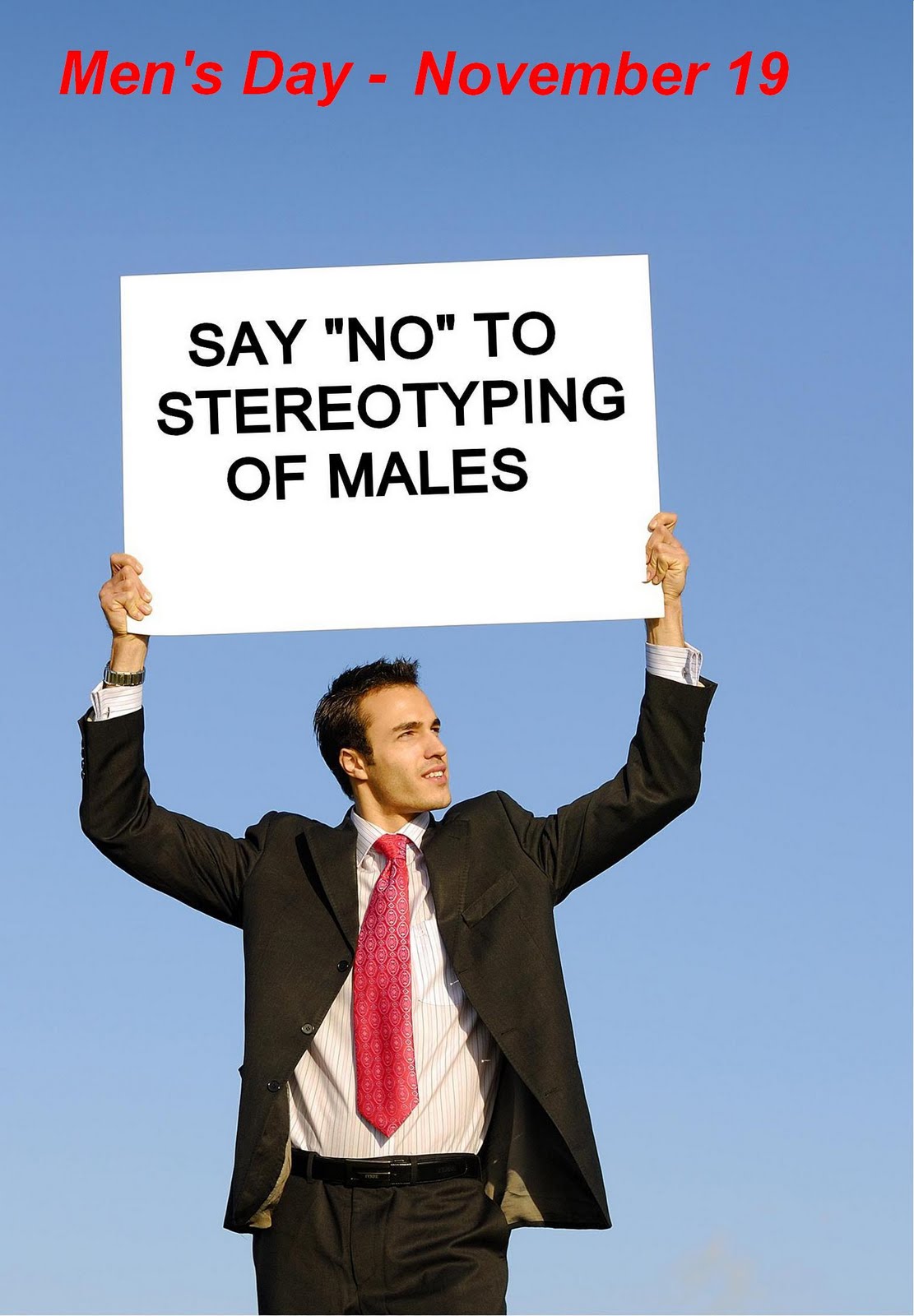
1. There is actually an International Men’s Day. November 19. Look it up. This is not to be confused with Men’s World Day– an event celebrated in Austria in the early 2000’s, awarding “exemplary” men (including the Bee Gees). Funnily enough the day was criticised for it’s gender-exclusivity and after being renamed, the main event is now (rather ironically) called the “Women’s World Awards“.

2. Promoting the idea that every day except this one is a default men’s day kind of reinforces the whole notion that every day is men’s day. It’s a catch-22. At what point do the days stop being gendered? Is there a point of “progress” where we finally sit back and go, “yep, equality achieved!”?

With these points in mind, I think that there is a fundamental problem with the current approach to women’s “equality” in the Western world, in that it often involves a tactic of “tipping of the scales“. This is an affirmative action strategy that says: to make up for all of the years of oppression and male privilege, women are now the ones that should be privileged. And often IWD involves celebrating the achievements of women, which is great, until it slips into essentialist generalisations about how women “keep the world together“. The thing that this particular mode of feminism overlooks is, well, men (and don’t even get me started on how this whole thing forgets people that don’t fit neatly into the man/woman gender binary!). Instead of focusing solely on “empowering” women to do anything, shouldn’t we be doing the same for men (and actually everyone despite gender), so that we achieve some balance and so that women aren’t expected to do everything?

We should be supporting men (and everyone!) in parental roles, men as caregivers and carers, celebrating the men that are community sector workers, teachers and nurses – i.e. men that do “traditional women’s roles”. As well as promoting women to be engineers, we should encourage men to enter primary school teaching. Instead, we just focus on the women – and that, I think, puts both a burden on women and denigrates men (and everyone outside the binary) in our society.

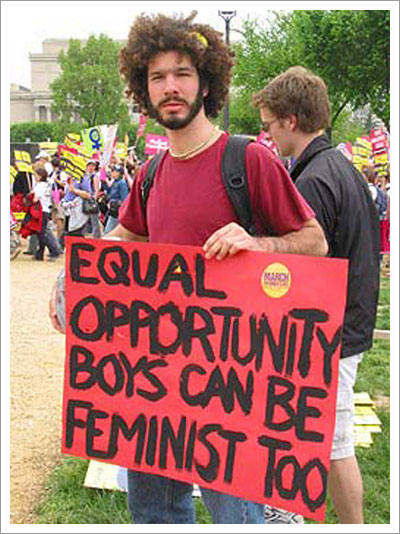
What about the men that we love? What about the men in our lives that are gentle and caring and believe in equality, but that get overlooked for scholarships, jobs and other positions because they are not women or are not cut throat competitors? And how on earth can we really empower women around the world, if we turn a blind eye to the role of men in these societies? What about the men in the world that are feminists? Surely we should celebrate and encourage them too. In the end, I appreciate International Women’s Day- I just don’t want to forget about men along the way.

Mmmm alphabet soup…tastes like rainbows

So last week I was asked to give a speech at my university’s local Mardi Gras celebration. Here it is:

“So what can I say about today’s Mardi Gras event? Well, I spend a lot of my days thinking about questions of gender, sex and sexuality, and the way in which we take up those specific identifiers that say, “Yes! This is who I am in the world”. I think that Mardi Gras is both about the personal and the political- celebrating who you are out loud, and demanding to be seen and heard. Mardi Gras is about opening up a space to talk about identity and belonging, and to have a discussion about things that might otherwise go unsaid and unheard.

As some of you may know, the Sydney Gay and Lesbian Mardi Gras changed its name to just “Mardi Gras” for this year’s festival. The organisers of the event said that they wished to promote greater inclusivity by dropping the “gay and lesbian”. And, as we celebrate our university Mardi Gras event today, we stand under a similar banner, designed to promote respect and equality for all people, no matter their sexual orientation.

While a central aspect of Mardi Gras might be inclusion, how do we make sure we don’t lose the alphabet soup along the way? I’m talking here about the ever growing acronym- LGBTIQAP, Lesbian Gay, Bisexual, Transgender, Intersex, Queer, Asexual, Pansexual… I could add more. How do we maintain our pride for who we are, without getting lost in the milieu of inclusion? While I agree that we are all equal despite questions of gender or sexuality, issues of visibility are ever-present. Being recognised, acknowledged, and respected for the person that you are, is a big deal.

Well, my thoughts on this are: say it out loud. For example, I am proud to say that I am a bisexual, queer, femme.

But this isn’t about labelling or having to “fit” into specific categories- it’s about naming our diversity and opening up new areas of discussion about identity. 

So let’s take this opportunity today to remember the alphabet soup, and in doing so, welcome everyone and anyone, under the ever expanding rainbow.

Happy Mardi Gras!”

Brain love and tear drops: the science of emotion

I came across Brent Hoff’s mini-documentary The Love Competition yesterday. Hoff, in conjunction with a bunch of Stanford University neuroscientists, ran and filmed a contest to see who could [neurochemically] love the most. It’s beautifully filmed, and Hoff approaches each individual that is interviewed with a gentle curiosity.

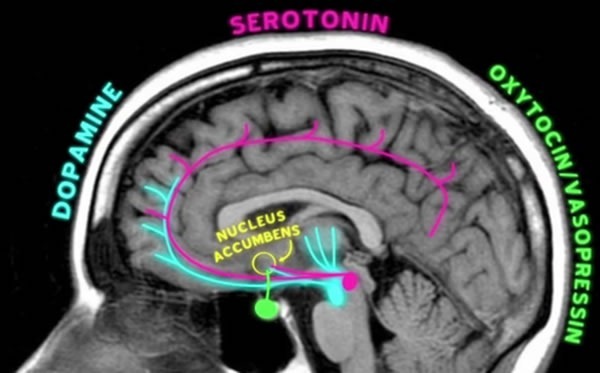
So how does one measure love? Aside from the general arm-span-width measure (“I love you this much!“), one might think that there’s not much concrete to go by. Hoff and his science buddies beg to differ. The love experiment placed contestants in an fMRI machine while they focused on their “love” emotion (and the object of their love). After the scanning was complete, the scientists measured activity levels in the brain regions most commonly associated with love.

But, despite the friendly and somewhat heartwarming nature of this doco, I can’t help feeling a bit dismayed by the whole notion that love is located in the brain. For one, love is abstract. Reducing it down to three brain pathways seems incredibly erroneous. I feel like trying to measure love with an fMRI machine is akin to attempting to understanding the ocean through examining some grains of sand on the beach- misguided.

Second, love is complex and diverse. What’s fantastic about the group of people selected for The Love Competition is that they all have extremely different notions of love, and focus on a vast array of love “objects” when they are in the machine. I particularly like the woman who decides to focus on love as internal and generated through chakra meditation- how interesting!

Third, I’m not sure how neuroscientists actually get to a point where they go, “yep, these are the love pathways“. The process of thinking love/ measuring thinking love/ ascertaining love areas/ getting someone else to think love/ measuring them against love areas- well, the whole thing seems like a self-fulfilling prophecy. What gets missed in this process?

Lastly, locating social concepts such as love in the brain can never end well. What if someone was put in the machine that could never produce any “love” activity- would we label them a sociopath? Does the woman crying at the end love her husband of 50 years less than he loves her?

Like Ron Burgundy reminds us, “You’re just a woman with a small brain. With a brain a third the size of ours. It’s science“.

It’s interesting to contrast The Love Competition with Hoff’s earlier work, The Crying Competition (don’t ask me why all these emotions have to involve competing, but whatever). In this, four men struggle so hard to produce a single teardrop that they quit after half an hour. When a woman sits down at the end, it takes just 20 seconds to deliver the salty goods. I think it’s easy to walk away from this video with a strong contention that men don’t [or can’t] cry. Certainly biological elements may factor into this (fluctuating levels of hormones certainly seem to make me tear up at some stages on the calendar). But what else might be going on?

Well, listening to the commentary from the men in the video almost seems to reveal an uncertainty about how to “get in touch” with emotions that lead to tears. I can’t help but wonder how much of this is a product of socialisation- a deep internalisation of the norm that men do not cry. But if we leave The Crying Competition video promulgating it as “proof” that men don’t cry, we perpetuate the very sentiment. 

I think that at the end of the day, what the Crying and Love competitions reveal, is that human expression about feelings is far more interesting than any scientific “measures” of emotion. One man in Crying even states that he is almost crying watching himself unable to cry- perhaps mourning the abstraction between masculinity and tears that his body has incorporated. Similarly, the disparate views expressed in Love reveal that there is a plethora of human experiences that we might call love.

The fact that the brain scans couldn’t adequately reflect these different experiences of “love” as relevant brain activity, shows us that such a neurochemical interpretation of love is flawed in the first place.